

- Introduction
- What is Topical Authority?
- Ways to Build Your Adult Website’s Topical Authority
- Common Topical Authority Mistakes To Avoid
- Conclusion
If you run an adult website, publishing more pages or adding more keywords won’t help you get traffic. Instead, making search engines understand what your website genuinely knows about, who it serves, and whether its content should be trusted is significant.
That is why topical authority matters!
Building topical authority means creating a useful ecosystem around your niche. This can cover the questions, concerns, terminology, and safety considerations. It should also cover practical information users actually look for.
When you create these well-researched and internally connected pages, backed by credible information, search engines get clear context while visitors get a reason to trust the site.
However, for adult websites, building topical authority can be harder. Sensitive subjects, strict search-quality expectations, competitive SERPs, and limited opportunities to promote your brand often make it difficult to establish consistent visibility.
If your website has dozens of disconnected articles, it may still look less authoritative than your competitor’s site that covers a set of related topics thoroughly.
In this blog, we’ll explore ways by which you can build topical authority for your adult websites while complying with all the guidelines.
What Is Topical Authority
It’s a misconception most marketers and businesses have that topical authority means publishing a number of blogs on the site.
That’s not true!
Topical authority is not a count of how many blog posts your adult website has published. It is the extent to which a particular subject is covered by a website, where individual pages work together rather than existing as isolated articles.
Consider an adult website selling sexual wellness. Publishing one article about the subject won’t establish much depth. To build a stronger topical structure, it can connect related information about sexual health, communication, intimacy, common concerns, safety, and product-related questions. Here, each page should address a different user need.
Search engines can identify these relationships through the words and concepts across pages, internal links, structured content, and the consistency of the information provided.
- Depth means addressing a subject thoroughly
- Relevance means staying closely connected to the site’s focus
- Coverage means answering the important questions within that area
- Content relationships show how those answers fit together.
It’s not about publishing everything but about building enough useful connections that both readers and search engines can clearly understand the site’s areas of knowledge.
Ways to Build Your Adult Website’s Topical Authority
Now that you know the real meaning of topical authority and that it comes from connected articles on a specific subject rather than content volume, the next step is deciding what your website should actually cover.
The following 10 approaches take that idea into practice, from defining your core subjects and mapping supporting topics to improving content depth, internal linking, credibility, and ongoing performance.
This is also where your adult SEO efforts need a more focused approach. Your content plan should reflect your actual niche, audience, products or services, and areas of knowledge rather than copying a generic SEO content calendar.
1. Identify The Core Topics of Your Website
To start with, define the subjects your adult website is genuinely qualified to cover. Your core topics should represent the main areas your site wants to be recognized for, while supporting subtopics should answer the narrower questions users have around each area.
For example, an adult sexual wellness website might have core topics such as sexual health, intimacy in relationships, and related products, with specific questions branching from one.
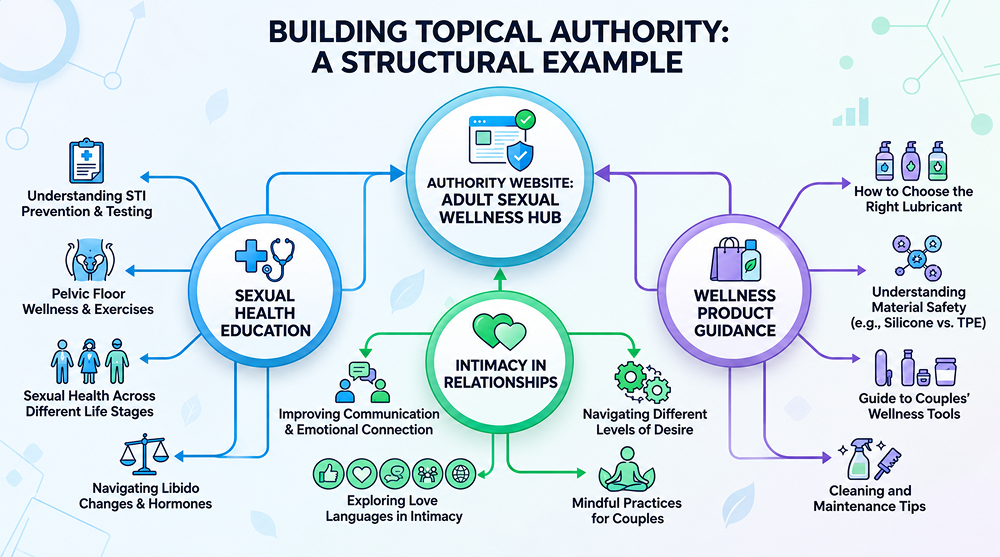
But before you add a topic in your content plan, ask:
- Does it serve our audience?
- Does it connect with our business?
- Does the topic fall within our actual knowledge or expertise?
If the answer is no, leave it out. A smaller, focused topical map is usually more useful than stretching the site into unrelated subjects simply to publish more content.
2. Build Topic Cluster Around Each Core Subject
Once you have identified your core topics, organize related content into topic clusters. Start with a pillar page that gives a complete overview of a major subject, then create supporting pages that answer narrower questions around it.
For example, a sexual wellness pillar could link to separate pages covering specific concerns, product types, safety questions, or relationship-related topics.
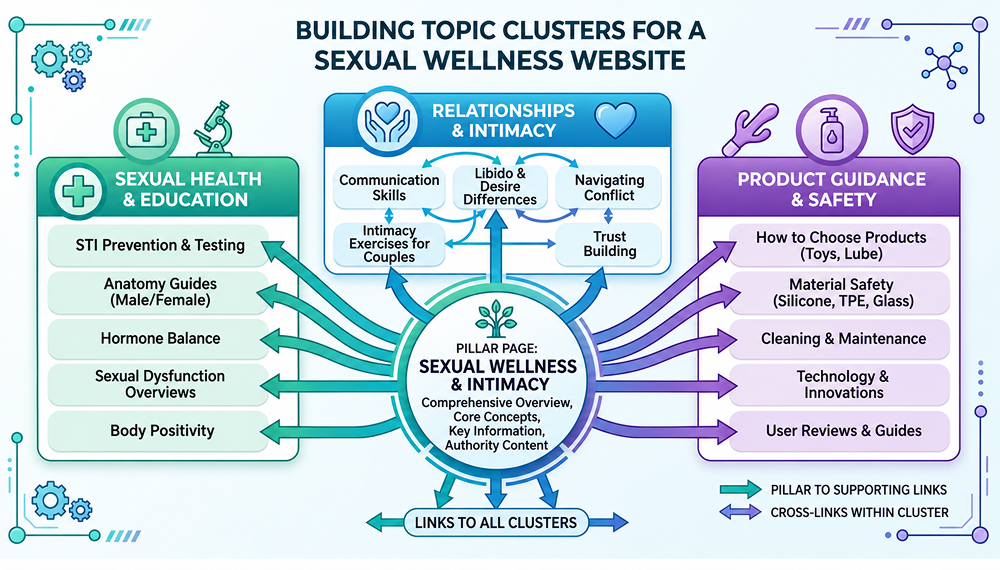
- Connect these pages with relevant internal links so users can move naturally between related information.
- Avoid rewriting the same information across every page.
- Each supporting article should answer a different question, and
- Add something useful to every topic.
3. Research What Your Audience Actually Searches For
Your content plan should begin with what people actually want to know, not what you think they might search for. Review search queries, related searches, autocomplete suggestions, forums, and questions people commonly ask about your niche.
Look beyond broad terms and identify long-tail questions, comparisons, and problem-solving searches that reveal specific information needs. Let’s say, users may search how to choose a particular product, whether a product is safe, or how two options differ.
Prioritize queries that are closely related to your site and useful to your target audience rather than chasing high search volume alone.
4. Create Comprehensive, Helpful Content
Each page should give the reader a clear answer without making them work through unnecessary information. Start by addressing the main question, then provide the relevant context, definitions, considerations, and practical guidance needed to understand it properly.
For adult topics, use clear, neutral language, and avoid exaggerated claims or sensational wording. A longer article is not automatically better; include information because it helps the reader, not simply to increase word count.
Also review important content on a regular basis, especially when product information, health guidance, regulations, or industry practices change.
5. Strengthen Internal Linking Across Topic Clusters
Internal links are important as they help readers move naturally from a broad subject to more specific information. Say, a main sexual wellness guide can link to detailed articles covering individual concerns, products, or related questions.
Use descriptive anchor text so readers understand what they will find after clicking. Review your website regularly for orphan pages and connect them to the appropriate topic cluster.
One interesting thing here is that strong internal linking should also support your broader adult link building strategy. It makes important pages easier to discover and strengthens connections between your key content.
However, avoid forced links; every link should have a clear purpose.
6. Show Your Expertise and Trustworthiness
Your readers and search engines should know the source of information. Clearly show the author of each article and, where relevant, mention their professional experience or qualifications.
If the content is about sexual health and covers medical advice, legal requirements, safety, or similar sensitive topics, support factual claims with reliable sources.
It also helps to have clear editorial guidelines explaining how content is researched, reviewed, and updated. Keep your About, Contact, and business information easy to find. These details make the site more transparent and help establish confidence in the information you publish.
7. Build Supporting Content Beyond Blog Posts
Many businesses make the mistake of limiting to just regular blog posts when it comes to building topical authority. The right approach is to build different types of resources based on what your audience needs to understand or find.
Guides can explain broader subjects, while FAQs can answer common questions quickly. A terminology or glossary page can clarify unfamiliar adult industry terms, and product or service pages can provide detailed information for people closer to making a decision. You can also create useful resource pages that bring related information together.
The key is to give each format a clear purpose instead of publishing different versions of the same content.
8. Build External Authority and Brand Signals
When relevant and legitimate websites mention your brand or website, you build external authority. However, it’s not about how many links you collect; quality matters.
To build external authority for your adult website, look for opportunities to contribute useful expertise to relevant publications, industry resources, communities, or specialist websites. Genuine brand mentions can also strengthen your reputation even when they do not include a link.
Moreover, focus on quality vs. quantity links: a few relevant, trustworthy references are more valuable than large numbers of unrelated or low-quality links.
Avoid paid link schemes, link exchanges at scale, private networks, or other tactics designed mainly to manipulate rankings.
9. Handle Sensitive and Adult-specific Topics Responsibly
You already know that your adult website needs extra care when publishing information that can affect health, safety, privacy, or personal decisions.
Keep claims accurate and clearly separate educational information from promotional material. For medical or safety-related topics, use credible sources and avoid presenting opinions as facts.
If your website collects personal information, explain what is collected, why it is needed, and how it is protected. You should also address age restrictions and applicable local laws. For user-generated intimate content, have a clear process for handling consent violations, complaints, and removal requests
Key Compliances and Regulations For Adult Websites
While there’s no single worldwide “adult website law”, the table below shows certain necessary compliances (can vary according to location) every adult website should take care of:
10. Audit Your Existing Content Before Publishing More
Reviewing your existing content on the website is a necessary step when it comes to building your topical authority. Before you add new articles, identify existing pages on your adult site that are attracting traffic, rankings, links, or engagement, and see how you can improve them.
At the same time, flag thin, outdated, irrelevant, or repetitive content. If several pages target the same search intent, consider combining them into one stronger resource instead of making them compete. Also, update your important pages before you create similar ones.
Finally, consider removing, redirecting, or reconsidering content that has no clear connection to your site’s core topics.
Common Topical Authority Mistakes Businesses Should Avoid
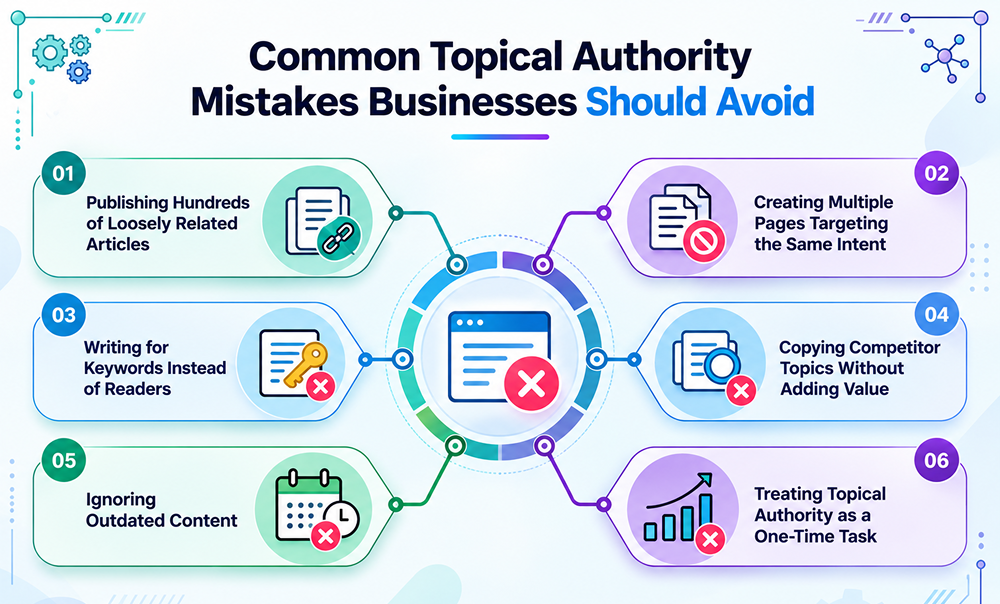
Small content decisions can gradually weaken your site’s overall authority. To avoid this, you should recognize the warning signs early so that your SEO strategy remains focused, consistent, and sustainable.
Publishing Hundreds of Loosely Related Articles
More content does not automatically mean more authority. If your adult website keeps adding unrelated subjects, it can affect your topical focus and make it unclear.
Fix: Start with your core topics and publish only content that genuinely supports them. A smaller, connected library is easier to manage and improve.
Creating Multiple Page Targeting The Same Intent
When several pages answer essentially the same question, they can compete with each other. Review overlapping pages and decide whether to merge them, redirect weaker versions, or give each page a clearly different purpose.
Writing For Keywords Instead Of Readers
Keywords should help you understand what people search for; they don’t dictate every sentence. So, write the answer first, use relevant terminology naturally, and remove anything that feels added only to rank.
Copying Competitor Topics Without Adding Value
The significance of competitor analysis is that it helps you understand useful gaps. But copying their content leaves no room for differentiation. Instead, look for questions they have missed, add better explanations, practical examples, original insights, or stronger sources. Give readers a reason to choose your resource.
Ignoring Outdated Content
As market trends, consumer behavior, regulations, and research evolve over time, existing content on your website can become irrelevant or outdated. Schedule content reviews and update pages when necessary. If a page is no longer useful or accurate, improve, consolidate, redirect, or remove it instead of leaving it untouched.
Treating Topical Authority as a One-Time Task
Topical authority is built with consistent maintenance. You can’t work on it for a while and assume it will keep growing on its own. Keep monitoring search performance, identify new questions, strengthen weak topic areas, and improve existing resources. Think of it as an ongoing content process rather than something you complete after publishing a fixed number of articles.
Final Takeaway
Building topical authority for an adult website was never about publishing more pages or targeting every adult-related keyword. It is about becoming a clearly defined audience.
Identify the core subjects, build useful, connected content around them, give every page a clear purpose, link related resources naturally, keep information accurate, and show readers who created and reviewed the content. For sensitive topics, responsible publishing, privacy, safety, and applicable regulations also matter.
Keep improving your content and remove outdated content to stay updated with industry upgrades. A focused, trustworthy content library will do more for long-term topical authority than publishing content simply to increase page count.