

- Introduction
- Key Takeaways
- What is Contextual Link Building?
- Why is Contextual Link Building Important for SEO?
- Contextual Link Building Vs Other Link Building Approaches
- How To Build High-Quality Contextual Links?
- Contextual Link Building Best Practices - A Quick Look
- Conclusion
- Frequently Asked Questions
A backlink may lead to your website, but it doesn’t inform the readers of your website much about what they should click on. Contextual link building is a different approach. It provides a link that is relevant to the discussion and leads the reader to a relevant destination rather than an unrelated one.
For example, an SEO outreach blog post can link to a more comprehensive article on strategies for identifying link opportunities. It is a clear correlation, which serves a purpose rather than just existing. This matters because strong link building is not about collecting links from as many websites as possible.
It’s all about getting the right links that are relevant to the content, audience, and topic and can help your search engines understand the relationship between your pages.
Let’s get into the details of it.
Key Takeaways
- Contextual links should be placed within content that is relevant and helpful.
- A link's value can be judged in terms of its relevance, placement, content, and destination page.
- Relevant links can also bring visitors who are genuinely interested in the linked topic.
- Contextual links can also draw in visitors who are actually interested in the subject that you are linking.
- Building a lot of backlinks is not enough; it is important to have quality ones.
What is Contextual Link Building?
A contextual link is a hyperlink that you embed naturally within the body of relevant content. It connects readers to another page that adds more information to the existing topic. The link should fit the location where it’s inserted; it shouldn’t appear inserted only to promote a website or improve rankings.
There are several parts that work together to create context:
- The linking page is the article that contains the link.
- The linked page is the destination readers reach after clicking it.
- Anchor text is the visible, clickable word.
The words and sentences around the link can explain why the destination is relevant. Search intent also matters. The linked page should help readers complete their next step, answer a related question, or understand the subject in greater detail.
Let’s say you are writing an article that explains enterprise SEO budgeting. While discussing costs, it links to a detailed guide on “Enterprise SEO Pricing”.
Inserting the link here feels natural because the linked guide answers in detail the question users may already have. In short, the link supports the discussion instead of interrupting it.
Contextual Vs Non-Contextual Link Building
Contextual Link Building |
Non-contextual Link Building |
|---|---|
| Appears within relevant content | Often appears in a footer, sidebar, or menu |
| Has a clear topic connection | May have little connection to the page |
| Gives readers more information | May mainly serve navigation or promotion |
| Fits naturally into the discussion | Can feel separate from the content |
Why is Contextual Link Building Important for SEO?
Contextual links are significant since they provide backlinks with a clear purpose. It does not link to it anywhere on the site but to related information that helps the reader and search engines. The significance of the value is not the link, but the context in which it appears.
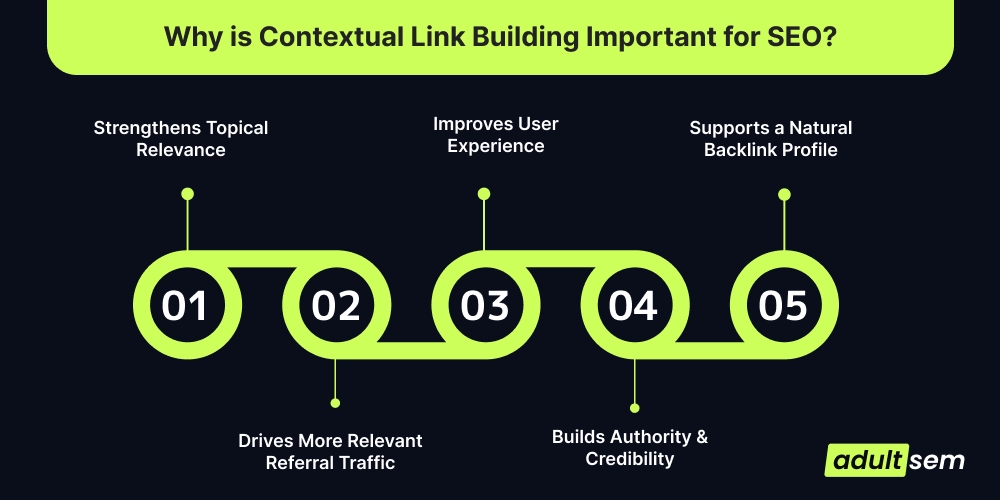
1. Strengthens Topical Relevance
Backlinks may help Google find pages and understand their significance. But one link is not a guarantee of higher rankings. Google takes into account several factors like relevance, quality of the linking page, page of the link, anchor text, and the value of the linked page.
A contextual link adds meaning to these signals since they are embedded in a relevant discussion. If the link is natural, it can be helpful for the search engine to determine what the linked page is about and its relevance to the main topic.
2. Drives More Relevant Referral Traffic
People tend to click a link when it answers a question they already have, which means contextual links can send visitors who are genuinely interested in your information or subject.
Relevant visitors are usually more valuable than random traffic. They read more pages, sign up for a service, request information, and make a purchase. In simple terms, when you have relevant content on your website, it brings more useful clicks, genuine visitors, and increases the chances of conversions.
3. Improves User Experience
A link, when placed at the right position, gives readers a logical next step. It can explain a difficult term, support a claim, or lead to a detailed guide without making users search for the information themselves. The link should help the reader first. If it feels forced or unrelated, it can affect the reading experience and reduce trust.
4. Builds Authority & Credibility
When reputed websites link back to your website or refer to your content, readers may see your brand as trustworthy. These references show that the information you present is useful enough to support another publisher’s content.
Yet, third-party scores such as Domain Authority or Domain Ranking are just estimates. They aren’t direct ranking goals. A website’s real value also depends on its reputation, content quality, audiences, and relevance.
5. Supports a Natural Backlink Profile
A healthy backlink profile includes links from different relevant websites, pages, and content types. This is more natural than relying on repeated links from poor-quality sites or paid placements.
Natural anchor texts are also important. Some links may use your brand name, while others may use a descriptive phrase or a simple word such as “this guide”. This variation reflects how people normally link to useful content and helps avoid an artificial pattern.
Contextual Link Building Vs Other Link Building Approaches
Many people mistake a contextual link for any backlink that is located within an article. A link, however, is not necessarily contextual when used in a paragraph; it must be relevant, explanatory, and informative, and it must point to a page that provides additional information.
A guest post can contain a contextual link when the article is about a topic that is relevant to the linked page. The same applies to a niche edit, where a link is added to an existing article.
Resource-page links can be useful when the page lists helpful guides, tools, or references. Directory and profile links may support basic brand visibility, but they usually offer less topical value. Links in the footer and sidebar are often used for navigation and may appear across many pages, so they carry less context.
Link Type |
Contextual Potential |
Main Value |
|---|---|---|
| Editorial In-Content Link | High | Relevance, authority, and referral traffic |
| Guest Post Link | High | Useful content, relevance, and exposure |
| Niche Edit | High | Link added to existing relevant content |
| Resource-Page Link | Medium | Helps users discover useful resources |
| Directory/Profile Link | Low | Basic brand and business visibility |
| Footer/Sidebar Link | Low | Navigation and sitewide exposure |
The real test is simple: Does the link make sense in that exact sentence and article?
How To Build High-Quality Contextual Links?
To build contextual links, start with creating something that is worth mentioning. Detailed guides, original research, useful statistics, case studies, calculators, and practical frameworks are strong choices because they give other writers a clear reason to link to your page.
Next, look for websites that already discuss your subject. Review competitor backlinks, search industry blogs, check resources pages, and use search phrases, such as “useful resources” or “recommended tools.” You can also find content gaps where an article needs information your page explains better. Existing brand mentions and digital PR opportunities may lead to natural link placements too.
Before contacting a website, check its quality. Is the topic relevant? Does it attract real visitors? Is the content helpful and well edited? Does it serve the same audience? Also check whether its pages appear in search results, whether it links out excessively, and whether it shows obvious spam signs.
Once you locate an appropriate page, propose a link that will be of value to the reader. Use anchor text that fits the sentence naturally. Do not force an exact keyword.
When doing outreach, make a personal note, explain the usefulness of your resource, and give a clear editorial reason (as to why it should be included). Don’t send the same message to all. Once you have acquired the link, verify that the link is indexed and active. Then track referral visits, rankings, referring domains, and conversions to gauge its true value.
Contextual Link Building Best Practices - A Quick Look
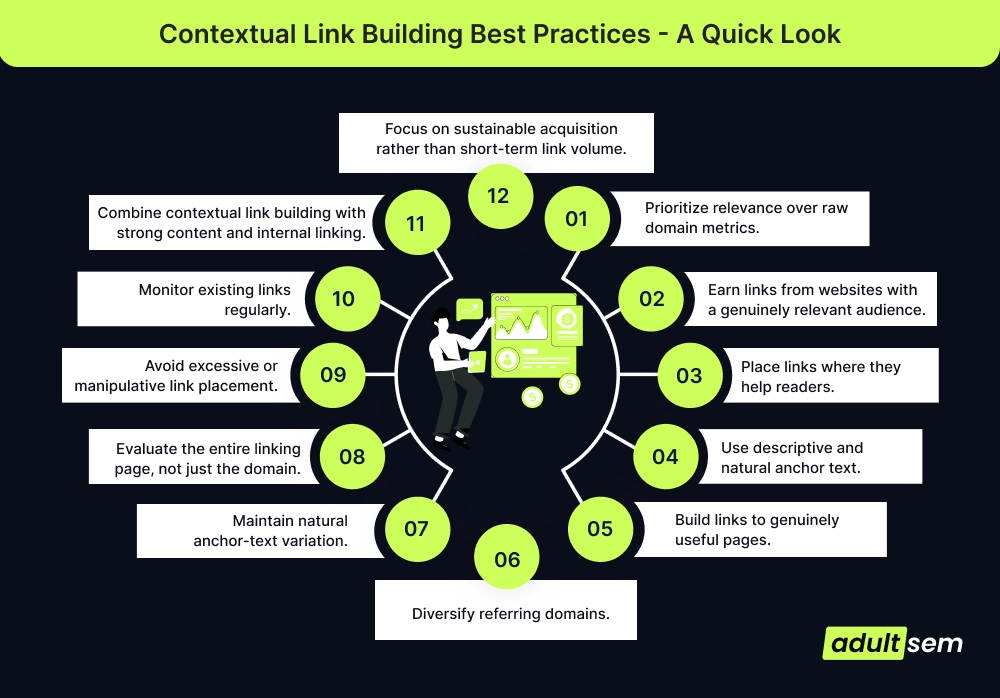
- Prioritize relevance over raw domain metrics.
- Earn links from websites with a genuinely relevant audience.
- Place links where they help readers.
- Use descriptive and natural anchor text.
- Build links to genuinely useful pages.
- Diversify referring domains.
- Maintain natural anchor-text variation.
- Evaluate the entire linking page, not just the domain.
- Avoid excessive or manipulative link placement.
- Monitor existing links regularly.
- Combine contextual link building with strong content and internal linking.
- Focus on sustainable acquisition rather than short-term link volume.
Conclusion
Contextual link building isn’t about getting as many links as you can. It’s all about creating links that are relevant, useful, and integrated naturally into valuable content. A strong link typically comes from a related website, on a relevant page, fits into the surrounding discussion, uses natural anchor text, and directs the reader to a helpful destination.
These factors are combined to make the link relevant to users and search engines. In many cases, it can be more valuable to have a handful of relevant and trusted links than several weak links. Before following any link, you should ask yourself: Will this help the reader, and will it fit into the content?