

Escort agencies face a different set of challenges when trying to stand out in local search. The industry comes with several marketing limitations, including restrictions around adult content. Google Business Profile (GBP) may also be unavailable or restricted for businesses in this category.
But the absence of GBP does not mean an escort agency cannot reach local customers. Local SEO can still create visibility through location-focused organic pages, trusted third-party mentions, technical SEO, local partnerships, privacy-conscious content, and strong first-party signals.
In this blog, you will learn:
- How local SEO can help escort agencies build visibility without relying on GBP.
- How to create location-focused pages that provide real value.
- How to build local authority through trusted mentions and partnerships.
- How to strengthen your website with technical SEO, privacy, and trust signals.
Let’s get started!
What are Escort agencies?
Escort agencies are businesses that connect clients with adult companions. Their websites typically provide information about available companions, service areas, booking procedures, and ways to contact the agency.
Unlike a simple directory, an escort agency may handle several parts of the customer journey. This can include managing companions’ profiles, responding to inquiries, coordinating appointments, processing bookings, and maintaining communication with clients.
The Real Local SEO Problem
Local SEO usually focuses on Google Business Profile, reviews, local rankings, and map visibility. But when it comes to escort agencies, those options may be limited depending on the business model and applicable Google policies. That means local SEO needs to focus more heavily on organic search visibility.
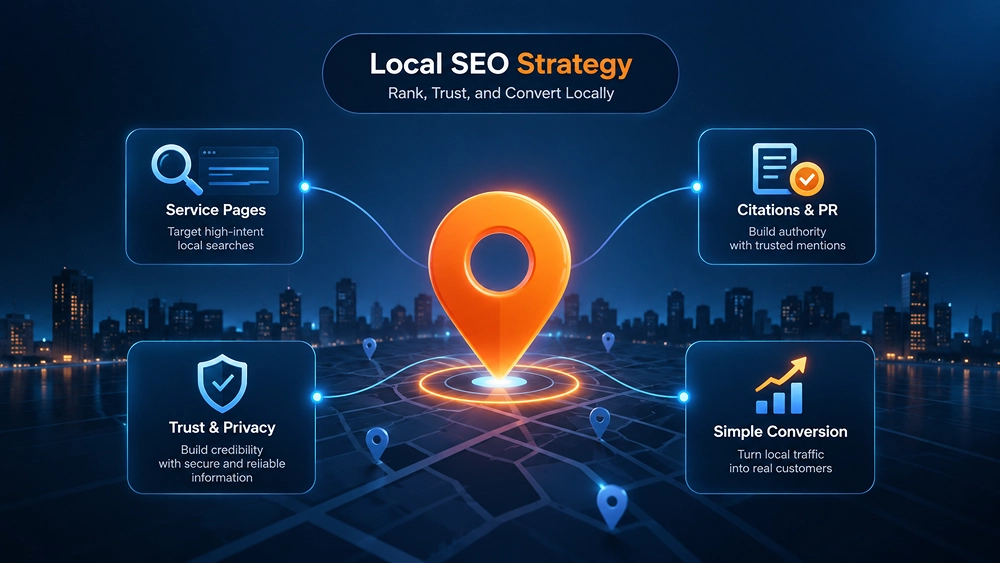
The goal is not simply to rank in the map pack. It is to make the agency’s website visible, useful, and trustworthy across relevant local searches.
As search engines like Google continue to evolve, the way websites build visibility is also changing. Google’s Search Essentials emphasizes helpful content, using the words people search for, crawlable links, and clearly communicating what a website offers.
Build a Strong Local SEO Foundation for Escort Agencies
Local SEO for escort agencies starts with building a website that clearly shows where the agency operates, what it offers, and how people can make an inquiry.
The goal is not to create as many location pages as possible. Each page should have a clear purpose and provide information that is genuinely useful to someone searching in that area.
Google warns against creating large numbers of low-value pages mainly to manipulate search rankings, including scaled content created without adding meaningful value.
Check this out: Google Search spam policies
Create a clear local site structure
For Escort agencies, it starts by organizing the website around the agency’s actual services and locations. This gives search engines a clearer understanding of how the pages are connected and helps visitors move from a location page to relevant service, safety, privacy, or contact information.
A typical structure could look like:
The structure should reflect the agency’s real operations. If an agency does not actually serve a city, it should not create a location page just to target that city’s search terms.
For an escort agency serving multiple areas, this structure also makes internal linking easier. A London location page, for example, can link to relevant privacy, safety, FAQ, and inquiry information instead of trying to answer every question on one page.
Make location pages genuinely local
A location page needs more than a city name in the title and URL. It should explain something specific about the agency’s presence in that market.
Depending on the agency’s operations and local requirements, a useful page can explain:
- Areas actually served: Mention the districts or surrounding areas where the agency operates instead of claiming an entire city without explanation.
- Service availability: Explain the general availability or service coverage so visitors know whether the page represents a real operating area.
- Inquiry process: Tell visitors how they can make a legitimate inquiry and what information may be required.
- Privacy procedures: Explain how inquiries and personal information are handled, especially where confidentiality is important.
- Safety and verification: Clearly communicate applicable age-verification, consent, and safety procedures.
- Local information: Where lawful and appropriate, useful information about transport or relevant local logistics can make the page more genuinely local.
- Location-specific FAQs: Answer questions that are relevant to people making inquiries in that particular market.
- Contact information: Give visitors a clear and discreet way to contact the agency.
Avoid creating pages such as:
“Best Escort Agency in London. Contact us for the best London escorts.”
If the same paragraph is reproduced for 20 cities with only the location name changed, those pages offer little reason to exist separately.
A stronger London page could explain which areas are served, how inquiries are handled, what privacy measures are followed, and what information is required before an inquiry is considered.
That gives the page genuine local value instead of making it another keyword-targeted landing page.
Match search intent to the right page
Not everyone who searches for an escort agency is ready to contact or book the agency immediately. Some searches are about finding the agency, while others are about understanding privacy, safety, or how the inquiry process works.
Let’s look at how search intent works:
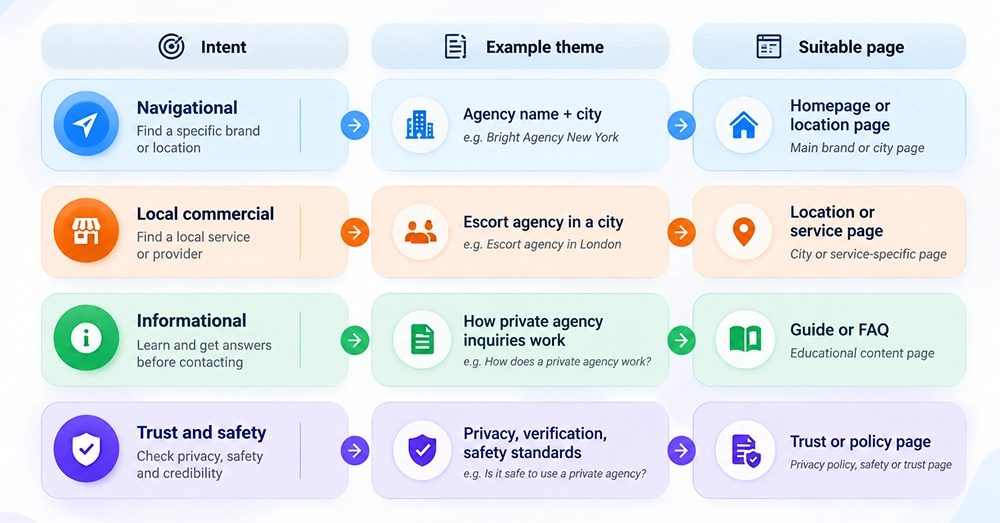
This gives the website a broader content structure instead of relying only on commercial location keywords.
Use terminology that accurately describes the business. Do not disguise the nature of the service simply to get around search or advertising restrictions.
Build a keyword-to-page map
Before creating new pages, assign each important search theme to the page that should answer it. Keyword research is crucial for adult websites to identify the right search terms and build an effective SEO strategy.
For example:
Search theme |
Primary page |
|---|---|
| Agency name | Homepage |
| Agency name + reviews | Reviews or testimonials page, where lawful |
| Escort agency in London | London location page |
| Private adult companionship London | Relevant London service page |
| How to contact an agency privately | Privacy or inquiry guide |
| Agency safety standards | Safety page |
This prevents several pages from targeting the same search and competing with each other.
It also makes internal linking more logical. A location page can link to the relevant safety guide, while the safety guide can link back to appropriate location or service pages.
Build trust and legitimacy into the website
Trust is particularly important for escort agencies because visitors may have concerns about privacy, legitimacy, safety, and how their information will be handled.
Create dedicated pages where they are genuinely useful:
- About: Explain who operates the agency and what it does.
- Contact: Provide legitimate ways to communicate with the business.
- Privacy policy: Explain what information is collected, why it is collected, and how it is handled.
- Terms of use: Set out the rules governing website use.
- Consent and age policy: Clearly communicate applicable age and consent requirements.
- Safety standards: Explain the procedures the agency follows.
- Verification procedures: Explain what verification is required and why.
- Complaint or support process: Give visitors a clear route for raising an issue.
- Editorial policy: Useful if the website publishes guides, research, or other editorial content.
- Media or partnership inquiries: Separate business and editorial inquiries from customer inquiries where appropriate.
Where legally and operationally appropriate, provide genuine business information such as the legal business name, operating entity, registration region, domain-based email, and responsible business contact.
Do not publish sensitive personal information about workers or clients. Privacy should be reflected throughout the website rather than treated as a small section hidden in the footer.
Use structured data carefully
Structured data can help Google understand what a page represents, but it is not a shortcut to higher rankings.
Depending on what is genuinely shown on the website, an escort agency may use markup such as:
- Organization
- WebSite
- WebPage
- BreadcrumbList
- FAQPage
- LocalBusiness
The markup must accurately represent the visible content. For example, an agency should not add fake reviews, claim a physical location that does not exist, or mark up services that are not actually described on the page.
For local business markup, only represent genuine business locations that meet Google’s requirements. If an agency operates as a service-area business or does not receive visitors at a public address, it should not create the impression that it has a public storefront simply for local SEO.
Handle explicit content separately
If the website contains sexually explicit images or other explicit material, separate that content from the site’s main commercial and trust pages where appropriate.
The core location, service, privacy, safety, and contact pages can remain focused on useful business information.
Also review how explicit material appears in:
- Image filenames
- Alt text
- Page titles
- Meta descriptions
- Open Graph information
- Sitemaps
- Image pages and galleries
Google provides specific guidance for sites containing explicit content, including ways to help its systems identify such material.
You can check here: Google explicit-content guidelines
Don’t use explicit imagery or wording in metadata simply to attract clicks. Structured data and metadata should describe the page accurately rather than being used as a way to manipulate visibility.
Earn local authority without risky link building
For escort agencies, local authority may require a different approach from a standard local business because Google Business Profile and some mainstream local directories may not be appropriate or available.
Instead of trying to build hundreds of directory links, focus on earning relevant third-party mentions.
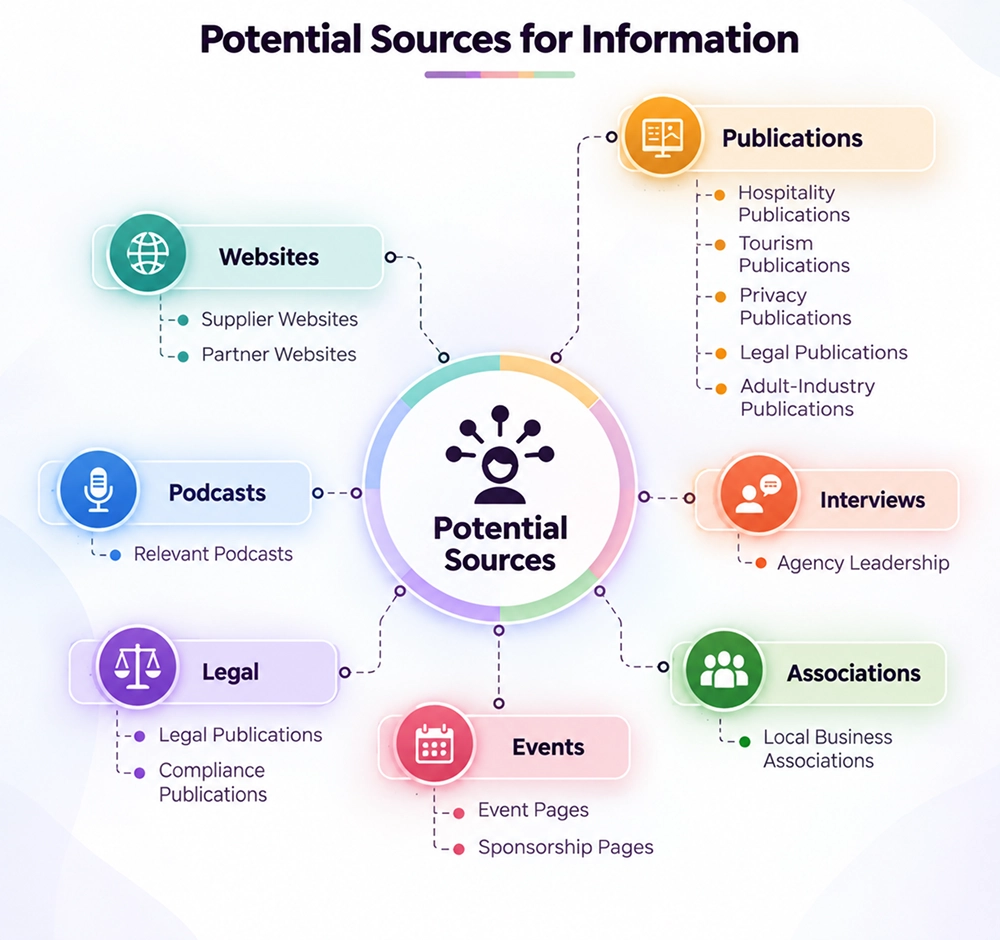
The important part is relevance. A mention from a publication that actually covers the local market or industry can provide more meaningful context than dozens of unrelated directory links.
Create resources that others can reference
Link building becomes easier when the agency publishes something useful beyond its own services.
For example, an agency could create:
- A privacy checklist for people contacting adult-service agencies.
- A guide explaining how to identify scams and impersonation.
- A safety checklist for adult-industry businesses, reviewed by a qualified professional where legal advice is involved.
- A directory of relevant support and reporting resources.
- Research into consumer privacy concerns using genuinely collected and anonymized data.
- A transparent agency standards charter.
The content should solve a real problem.
The strongest linkable resource is not another “hire us” page.
Avoid common off-site SEO risks
Some link-building shortcuts can create more problems than they solve. They can even put your website at risk of a Google penalty. That’s why it’s important to understand which adult SEO mistakes can put your website at risk.
Don’t Do:
- Paid links intended to pass ranking credit.
- Automated directory submissions.
- Private blog networks.
- Fake local news websites.
- Review manipulation.
- Forum spam.
- Links from hacked or compromised websites.
- Fake awards.
- Fabricated “best agency” claims.
Google’s spam policies cover manipulative practices, including scaled content abuse and other forms of search spam.
For a sensitive industry, the goal should be credible visibility that can withstand scrutiny, not a large backlink count.
Make local traffic easier to convert
Ranking for a local search is only one part of the strategy. Once someone reaches the website, the next step should be clear without asking for unnecessary personal information.
Useful conversion elements include:
- A discreet contact form.
- A domain-based email address.
- A clear response-time expectation.
- Privacy information close to the inquiry form.
- Minimal data collection.
- HTTPS.
- A neutral confirmation message.
- Mobile-friendly navigation.
- Clear age and consent requirements.
- No forced account creation unless necessary.
- No exposure of client or worker information.
For example, an inquiry form can explain what information is required, how the information is stored, who can access it, and what happens after the form is submitted.
That reduces uncertainty while keeping the process straightforward.
Cover the technical SEO basics
Once the site structure and content are in place, technical SEO helps search engines crawl and index the pages that actually matter.
Indexation
Check that important location and service pages can be crawled and indexed.
Focus on:
- XML sitemap submission through Google Search Console.
- Indexable location and service pages.
- Consistent canonical URLs.
- Duplicate location-page checks.
- Pagination and faceted navigation.
- Proper handling of expired pages.
- Accessible CSS and JavaScript.
- Regular monitoring of indexing and search queries.
Search Console can then be used to compare impressions, clicks, CTR, and average position for individual pages and queries.
On-page SEO
Each location page should have its own purpose rather than following one template with a city name substituted.
Check that pages have:
- A descriptive title.
- A clear H1.
- A unique meta description.
- Natural location references.
- Descriptive internal anchor text.
- Useful image alt text.
- Relevant links to safety, privacy, FAQ, service, and related location pages.
- Short, descriptive URLs.
- Content that matches the search intent.
Performance and mobile usability
The site should also work well on mobile devices. Pay particular attention to pages containing inquiry forms because a slow or difficult form can lose visitors before they contact the agency.
Test:
- Largest Contentful Paint
- Interaction to Next Paint
- Cumulative Layout Shift
- Form usability
- Tap-target spacing
- Image loading
- Intrusive interstitials
- Browser back-button behaviour
Google’s Core Web Vitals are designed to measure real-world loading performance, interactivity, and visual stability.
Measure local visibility beyond rankings
Don’t measure the strategy only by whether a location page appears in a particular position.
Track what happens before and after SEO improvements:
- Organic impressions by city.
- Organic clicks by landing page.
- Non-brand clicks.
- Growth in brand searches.
- Searches containing location names.
- Organic inquiries.
- Form completion rate.
- Returning visitors.
- Referral traffic from local publications.
- Crawl and index coverage.
- Mobile vs desktop performance.
- Conversion rate by location.
A simple monthly report can segment the data like this:
Segment |
What it tells you |
|---|---|
| Brand vs non-brand | Whether the site is attracting searches beyond existing brand awareness |
| City vs national | Whether location pages are bringing relevant local visibility |
| Mobile vs desktop | Whether the site works effectively across devices |
| New vs returning | Whether visitors come back after their first visit |
| Organic vs referral | Whether SEO and digital PR are both contributing traffic |
| Informational vs commercial | Whether supporting content is contributing to the customer journey |
One practical way to measure improvement is to compare a location page’s impressions and inquiries before and after adding unique local information, improving internal links, and strengthening trust content.
This gives the agency a clearer picture of whether the SEO work is generating useful local visibility and actual inquiries, rather than simply producing more indexed URLs.
Final Says!
Local SEO for escort agencies requires a different approach from traditional local marketing. Without relying on Google Business Profiles, the focus shifts toward building a website that search engines can understand and users can trust.
When the technical foundation, local relevance, credibility, and user experience work together, agencies can create a stronger organic presence and stay visible for relevant local searches over time.