

Summary
Quality matters more than quantity in adult link building because a backlink is valuable for more than simply existing. Relevance, editorial context, referring site quality, placement, anchor text, and the relationship between the linking page and the destination all matter. A smaller number of useful, relevant links can create a stronger link profile than a much larger collection of unrelated or manipulative placements.
When evaluating a backlink campaign on the basis of monthly numbers, it is all too easy to conflate effort with achievement. A sheet listing 500 links per month is going to look better than one listing only 30. However, the numbers tell you very little about relevance, editorial significance, or value of these links.
The situation is particularly critical for adult sites. Fewer publishers will be willing to cover your adult business than the same business in many other industries. So the random acquisition of links is likely to waste your budget. Instead, you need to select the opportunities wisely and acquire links that make sense for the page, publisher, and audience.
This does not necessarily mean that every backlink needs to come from the top site in the niche. It just needs a reason to exist.
- Introduction
- What Makes a Backlink Valuable?
- Why More Backlinks Do Not Automatically Mean Better SEO
- Why Topical Relevance Matters in Adult Link Building
- Authority Matters, But It Is Not Everything
- Quality Backlink vs Weak Backlink
- Why Context Matters More Than a Link Alone
- How to Evaluate an Adult Link Building Opportunity
- Adult Link Building Needs More Selective Prospecting
- Why Low-Quality Link Tactics Create Unnecessary Risk
- Quality vs Quantity: A Practical Example
- How Internal Linking Supports a Quality Link Strategy
- Adult Link Building vs Traditional Link Building
- FAQ
- Final Takeaway
What Makes a Backlink Valuable?
A valuable backlink is one that fits naturally into the web ecosystem around it. The source page should have a clear reason to mention the destination, and the destination should give the reader something useful after the click.
There are several qualities worth reviewing together:
1. Relevance
Relevance is the relationship between topics. The connection between a sexual wellness website that has a link to a sexual wellness guide is clear. The connection between a dating website and a resourceful guide on relationships is also sensible. On the other hand, there is little to connect between a website on some irrelevant consumer topic.
2. Editorial context
The contextual link is there to add explanation or context on a certain part of the article. This is unlike when the link is placed in an article just because there is space in the article to put a link and nothing else. A simple question to ask is: what will happen when the link is taken out? Is there loss of context? Yes, then there must be a good editorial reason for placing the link.
3. Quality of referring site
Go through the site’s real content, publications, audience, indexable pages, and outbound links. There might be a better choice of a site with a lower metric, but relevant topical fit and an actual audience.
4. Placement
It’s important where the link is placed on the page. A good link in a useful article, placed within its text, gives the context to the user. A link placed in a sitewide footer, author profile or even just in the template has no editorial value at all. Any link should always be considered along with the surrounding text.
5. Relevant anchor text
Anchor text is a visible part of a link. Good anchor text gives the idea of what users can expect to see when following the link, and provides useful context for search engines. The anchor text should not contain all possible keywords. According to Google, descriptive and relevant anchor text helps Google and people understand the content of the linked page.
Why More Backlinks Do Not Automatically Mean Better SEO
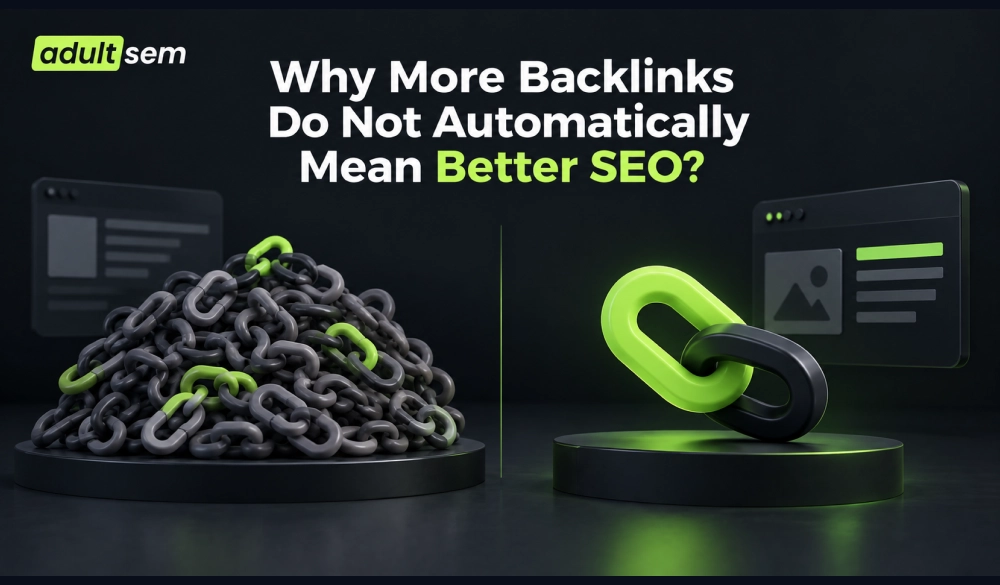
Backlinks can be measured easily, which makes them popular as a headline statistic when presenting monthly reports. That doesn’t make them the ideal measure of quality for links.
Think about two imaginary link building campaigns:
The first one creates 600 links on general directories, profiles, and unconnected websites, while the second one generates 45 links on pages from sources that are directly related to your business and editorial content. The first one wins in terms of quantity. The second one might have a lot stronger editorial background.
Why Topical Relevance Matters in Adult Link Building
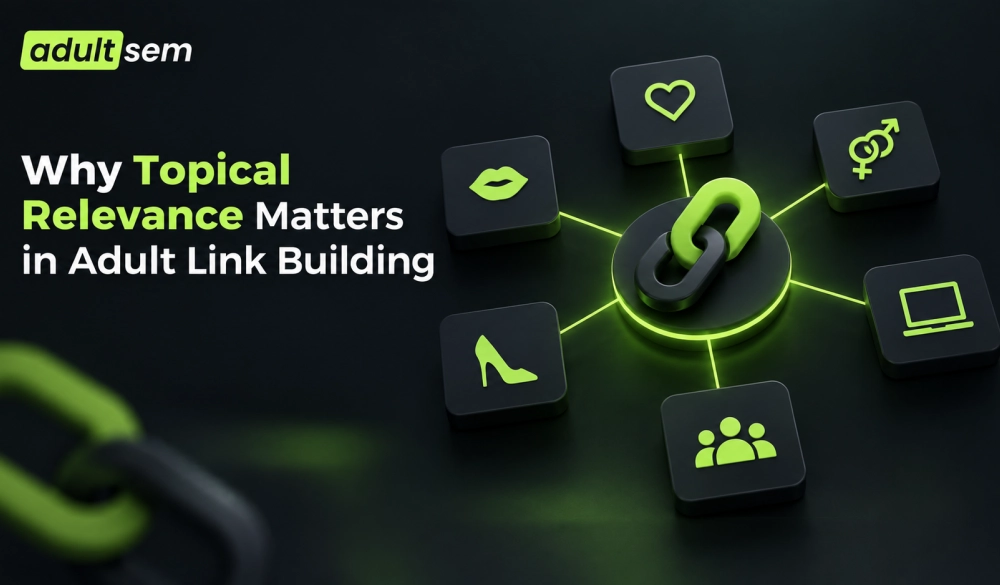
Topical relevance is important because there are connections within the content, and there is content within the topics. The more connected the linking page and the destination are, the easier it will be for the visitor to realize the reasons behind the connection.
Adult SEO does not boil down to a general principle of each link having to be made from an adult site. It is too narrow-minded. A relationship publication, sexual wellness guide, dating site, creator economy guide, or relevant technology website could be an appropriate choice when the individual page and its audience are related to the topic.
The right test is not “Does this domain contain adult content?” The better test is “Does this page have a credible reason to reference this destination?”
Authority Matters, But It Is Not Everything
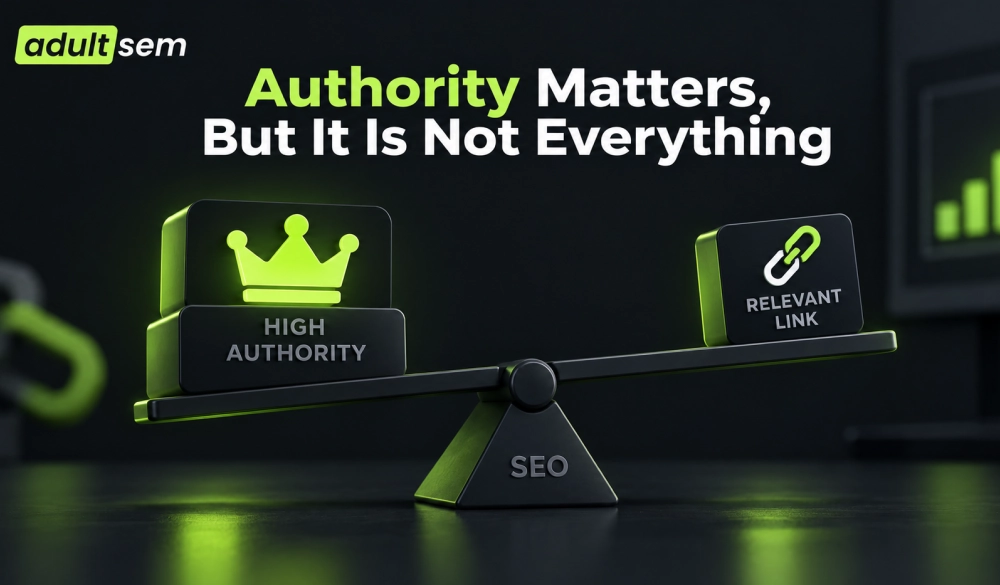
Authority is helpful because reputable sites often have a good reputation, useful audiences, and valuable link equity. However, authority metrics are estimates calculated by SEO tools and not Google scores.
Therefore, a thorough assessment should consider authority in conjunction with relevance, editorial quality, and site reputation.
For instance, consider a publication on sexual wellness with mediocre third-party metrics, editorial slant, informative content, and a useful audience. Compare it to another site that scores much better with the same SEO tool and yet has many off-topic and commercially motivated articles.
In other words, the key takeaway from this is straightforward: use authority metrics to identify opportunities, not make your final decision.
Quality Backlink vs Weak Backlink
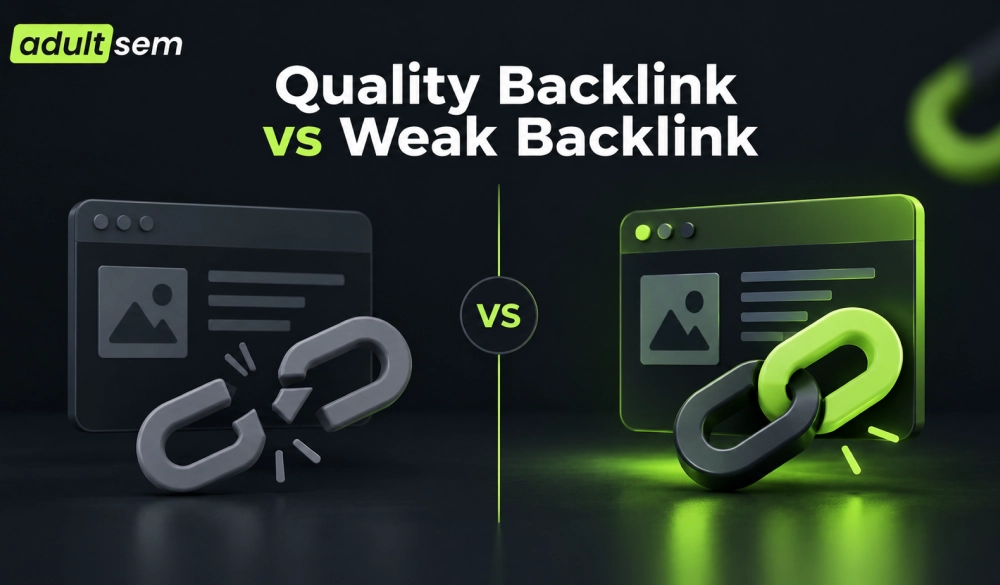
Quality Factor |
Stronger Opportunity |
Weaker Opportunity |
|---|---|---|
| Relevance | Closely related subject and audience | Unrelated subject with no clear connection |
| Editorial Context | Link supports a useful explanation | Link appears mainly because a placement was purchased or requested |
| Content Quality | Original, useful and maintained | Thin, repetitive or low value content |
| Authority | Credible site with a healthy profile | Metric-focused site with suspicious patterns |
| Anchor Text | Natural and descriptive | Repeated commercial exact match wording |
| Placement | Relevant body copy or useful resource section | Random profile, footer or template placement |
| Site Reputation | Clear purpose and credible publishing history | Large volume of unrelated commercial links |
Why Context Matters More Than a Link Alone
Backlinks do not operate in a vacuum; the context in which they appear determines their significance.
Let’s say an article talks about how couples can go about comparing sexual wellness products. In this context, a link to an extensive buying guide will make sense and encourage further investigation on the part of the user. If that same link appears in an article having nothing to do with it, such as one about cell phone accessories, there will be no corresponding need for context.
This is one reason why the surrounding sentence must be considered when evaluating anchor text. Google recommends using descriptive and concise anchor text and avoiding keyword stuffing within links.
Context is also important in maintaining high editorial quality. A website that posts well-written articles that occasionally cite useful resources has quite a different outbound link strategy than one that produces many nearly identical promotional articles.
How to Evaluate an Adult Link Building Opportunity
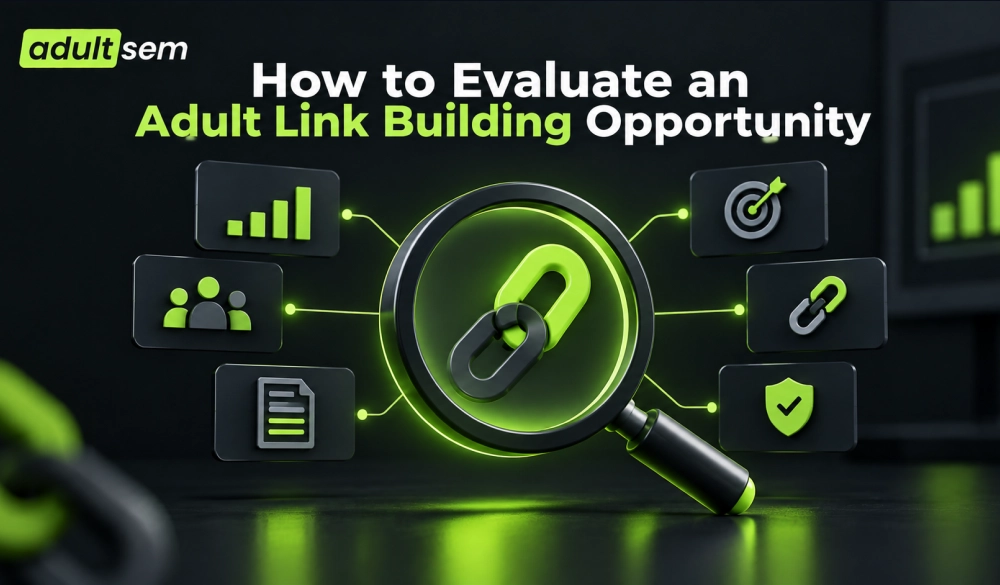
A good qualification process can be systematic without becoming complicated.
Step 1: Examine the topical relevance
Check both the referring domain and the specific page. Determine the theme, intended audience, and purpose of that page. A high level of thematic proximity is always favorable; however, do not force the connection.
Step 2: Consider the publisher
Go through a few recent pages of this website and determine whether the website has a clear purpose, quality content, and any evidence of maintenance. Pay attention to how many commercial links are present on the site.
Step 3: Examine the linking opportunity
Check the exact page where the backlink will be placed and the paragraph of the page where the backlink will be placed. The good placement of the backlink should help to make the information more understandable for the visitor.
Step 4: Examine the destination
The target page should be worthy of a reference. If the destination is thin, badly written or irrelevant, then a good-quality publisher means nothing.
Step 5: Examine the anchor text
Opt for descriptive phrases that would work within the sentence. It is not good practice to conduct an entire campaign based on one commercial keyword phrase. More descriptive phrases tend to give the impression of editorial content.
Step 6: Test for indexability and crawlability
If the objective is search and discovery, then both pages need to be technically accessible by search engines. Regular crawlable links are better than any type of link using special script codes.
Adult Link Building Needs More Selective Prospecting
The adult industry has its own publishing realities. Some mainstream publishers have policies that restrict adult-related content, while adult-focused publishers may have smaller but more relevant audiences. That changes the prospecting process.
A smaller pool of suitable publishers is not a reason to lower the quality threshold. It is a reason to improve qualification.
Why Low-Quality Link Tactics Create Unnecessary Risk
What is problematic about poor-quality link acquisition is not the risk of ignoring links that could provide benefits, but the fact that Google currently considers activities like purchasing or selling links with the purpose of ranking, automated linking, excessive link exchanges, and specific paid or distributed content links as link spam in its current policy against spam.
This means that it is crucial to understand what the goal of the particular campaign is. An honest business deal does not mean buying ranking influence. According to Google’s recommendations, a paid link must be annotated with appropriate attributes of the link.
When building a profile for an adult site, it would be better to make sure that it can be justified using editorial reasoning: the publisher discussed a relevant topic, the destination was helpful to the reader, and the link was needed.
Quality vs Quantity: A Practical Example
Here is a hypothetical example, not a documented case study.
An adult dating platform has two available outreach plans. Plan A promises 400 placements across directories, profiles, and general websites. Plan B targets 35 carefully selected placements from dating publications, relationship resources, sexual wellness publishers, and relevant technology sites.
Plan A wins on raw volume. Plan B wins on selectivity.
The second plan may produce a more coherent profile because each link has a clearer topical and editorial reason. It may also create referral traffic from readers who are already interested in the subject.
There is no fixed formula saying that 35 links are worth a specific number of 400 links. Link value cannot be reduced to a simple exchange rate. The point is that link quality should be evaluated by context, not by arithmetic alone.
How Internal Linking Supports a Quality Link Strategy
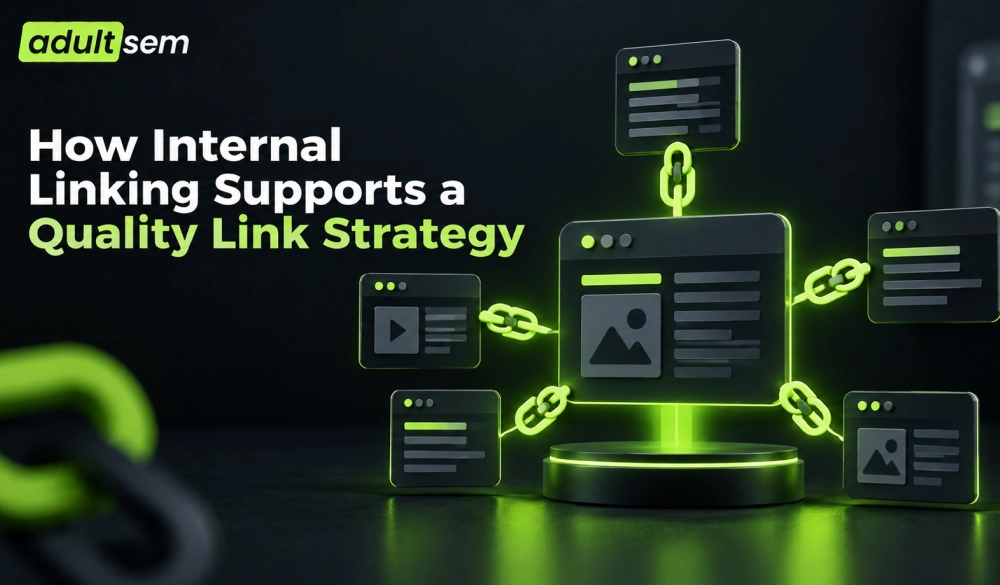
External backlinks are only one part of the authority and discovery picture. Internal links help users and search engines move between related pages on your own site.
For example, a new editorial backlink can point to a strong guide, while that guide can internally connect readers to related service pages, supporting resources, and relevant topic pages. This creates a clearer path from discovery to deeper content.
For broader context, see AdultSEM’s guide on the benefits of link building for SEO.
If you are building a topical cluster around adult search behavior, the site’s adult keyword research guide can also support the relationship between keyword intent, content planning, and internal linking.
Adult Link Building vs Traditional Link Building
Adult link building still follows the core principles of relevance, editorial quality, and useful content, but publisher availability and acceptance criteria can differ.
AdultSEM’s comparison of adult link building and traditional link building discusses those differences in more detail.
That distinction matters because a strategy copied directly from another industry can lead to poor prospect selection. The right approach is to preserve the quality principles while adapting the publisher research and outreach process to the market.
Final Takeaway
The simplest form of link-building report that can be made is a link count. However, a more valuable link-building report involves the reasoning behind why such links have been obtained.
This requires adult sites to pick only certain publishers that are relevant to them, to check for the relevancy of the links, the placement of the link, the anchor text used, and also to determine whether the destination page is worthy of citation.
A big number of backlinks does not necessarily mean that one has an effective backlink profile. The ideal goal should be to have a collection of credible and useful links to the website that makes sense to visitors and also passes the editorial relationship test.
This is the difference between going for quantity and quality. If you are searching for reliable adult link-building services, get in touch with our industry expert today.
FAQ
Is it true that one good backlink is better than a lot of weak backlinks?
This could be correct. An editorial link from a reliable resource is better than a huge number of irrelevant links. There is no universal mathematical formula for converting the quality of backlinks to their quantity.
What are the criteria for a good backlink for an adult web resource?
A good backlink should have topical relevancy, meaningful context, a credible referring web resource, proper placement of the link, and natural anchor text. Besides, it should refer to a page that really deserves being referenced.
Do all backlinks of adult websites necessarily have to originate from adult websites?
Relevancy is more important than industry. It may be appropriate to use a link from a relationship, sexual wellness, dating, or technology resource if the particular page is really relevant to it.
Is it enough to have high authority to accept a backlink?
Not always. Authority is just a third-party estimate of a website. Check relevance, content quality, audience metrics, outbound link structure, and placement before accepting the backlink.
How should the anchor text be done in adult SEO?
It is advisable to use natural and concise phrases as the anchor text and not base the entire SEO campaign on the same commercial match phrases.
How many backlinks does an adult website require?
There is no universal number. The right pace depends on competition, existing authority, content quality, the current link profile, and the strength of competing pages.