
As an adult brand, it might be easy to publish an adult video. What becomes difficult is getting Google to discover it, understand it, and show it to the right audience.
When it comes to adult video SEO, it goes beyond just adding keywords to a video title or description. For Google to consider it, it needs to access your video and watch page, understand what the video is about, and determine whether it can be shown for relevant searches. While your page may be indexed, Google may still find it difficult to understand or display your video.
Besides, adult brands need to be extra thoughtful about their explicit content. SafeSearch, age gates, content classification, crawler access, and video availability can all affect visibility. These are systems that SEO can’t bypass or ignore.
So, if you’re struggling to get your videos in Google Search, this guide can explain how video SEO for adult websites works. It also discusses getting adult videos indexed and improving their chances of appearing in Google Search and Video results.
Quick Answer: How Do You Get Adult Videos Found in Google?
To improve the chances of getting your adult videos in Google, make sure Google can crawl both the page and the video file. Every important video page should have its own indexable page. Use clear titles and helpful text that match what people actually search for. Adding a crawlable thumbnail, implementing VideoObject, and submitting a video sitemap can help. Your website should also clearly identify explicit content and avoid blocking Google from accessing important video resources. These steps can help Google understand your adult videos and index them. However, getting a video indexed in Google doesn’t guarantee video search visibility or rankings.
How To Make Your Adult Videos Discoverable and Indexable By Google?
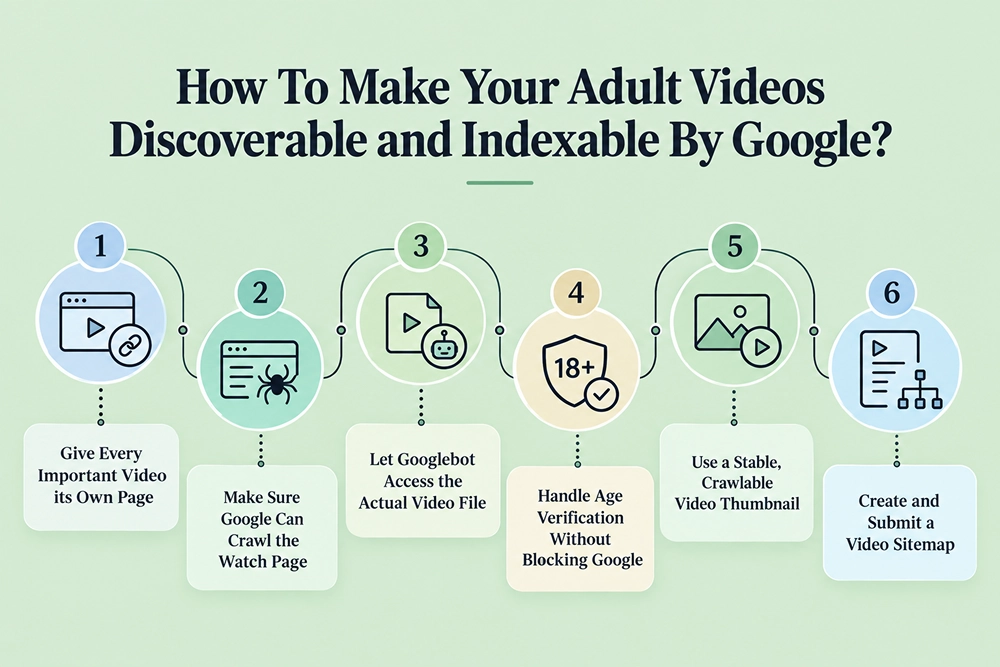
The right technical setup is the foundation of adult video indexing. If Google is unable to easily reach the page, video, or thumbnail, even strong content optimization may have little impact.
Here’s what your adult brands should get right first:
1. Give Every Important Video its Own Page
If you want an individual video to appear in Google, consider giving it a dedicated, indexable URL. Your video should be the main content on that page, not one item buried among hundreds of other videos.
For example, /videos/video-name is a stronger setup than placing every video on one generic /videos/ page. Link important video pages from relevant category, tag, or related-video pages so Google can discover them through your site structure.
2. Make Sure Google Can Crawl the Watch Page
You may have a video page, but it can still be difficult for Google to process. Check that it is not blocked by robots.txt, noindex, login requirements, incorrect canonical tags, or server errors.
Also, check for pages where JavaScript loads the video only after a user interaction. Google needs to access the page and understand where the video is available. According to Google’s video guidelines, the watch page of the video should also be indexed along with the video to be embedded or otherwise available on that page.
A simple crawl check can uncover issues such as:
- 4xx or 5xx HTTP errors
- Accidental noindex
- Incorrect canonical URLs
- Blocked scripts or video resources
- Login-only access
- Video content that never becomes available to crawlers
3. Let Googlebot Access the Actual Video File
This is especially important for adult websites. Google recommends allowing bots to fetch your actual video files. If Google cannot access the video content, its system may not be able to process the video properly. As per Google, this can significantly affect visibility, particularly in Video mode.
So, don’t just check whether Google can open the watch page, but also check whether it can reach the actual video resource.
TL;DR: Can Google index a video if Googlebot can’t access the video file? It may still understand parts of the page, but restricted video access can limit Google’s ability to process the video and can hurt visibility.
4. Handle Age Verification Without Blocking Google
Verifying age can be important for visitors, but it shouldn’t make your content invisible to Google. The giant search engine recommends allowing verified Googlebot requests to crawl the content without triggering the age gate. Otherwise, Google may not be able to fetch important page elements, including video content or images, which can affect how the page is understood and ranked.
This is about making your content technically accessible to search engines, not bypassing Google’s policies or SafeSearch.
5. Use a Stable, Crawlable Video Thumbnail
Every important video should have a unique thumbnail that Google can fetch. Keep its URL stable and avoid changing it every time the page is updated. Google’s VideoObject guidance requires a thumbnail URL and recommends a unique thumbnail for each video.
A broken, blocked, or frequently changing thumbnail can make it harder for Google to understand and represent your video correctly.
6. Create and Submit a Video Sitemap
A video sitemap gives Google another structured way to discover the videos on your site. It can include details such as the thumbnail, video title, description, and the location of the video or player.
For an adult video sitemap, you should pay particular attention to:
- video : thumbnail_loc - the video thumbnail
- video : title - the video title
- video : description - a useful description
- video : content_loc - the actual video file, where applicable
- video : player_loc - the video player URL, where applicable
- video : family_friendly - set to no for explicit videos
Google specifically suggests using <video : family_friendly><no>>/video : family_friendly> for explicit videos. This way, Google can decide which videos to hide or not show when SafeSearch filtering is enabled.
Your video sitemap works alongside your normal XML sitemap; it does not replace it. Once created, submit the sitemap through Google Search Console and keep it updated as videos are added or removed.
The goal is simple: Make every important video easy for Google to find, access, understand, and classify. That technical foundation gives your content a much clearer path into Google Search.
These checks can also be used as a pre-publishing checklist for your development and SEO teams. The next step is about making Google understand what each video is about and why it matches a specific search.
How To Optimize Your Adult Video Page for Google Search?
Once you set up a smooth technical foundation for your adult video, the next step is on-page optimization. It helps Google and users clearly know what the video is about. A technically accessible video still needs useful context to compete for relevant searches.
1. Target the Search Query Behind the Video
When it comes to video SEO, it should start with the search intent and not a keyword list. Think about what someone would type when looking for the type of video you publish. That can help you build your keyword list.
Searches may be based on a category, topic, descriptive attribute, creator or stage name, location, or format. For example, a user may search for a specific category, a creator’s videos, or a particular format such as an HD video.
So, you should build each page around one primary search query. Then, use relevant secondary and long-tail terms naturally and add related words that help explain the topic and the category.
However, do not force the same keyword into every heading and sentence – a common adult seo mistake brands make. Remember, keyword stuffing can make a page feel unnatural and does little to help users.
A useful test is simple: if you removed the video, would the page text still clearly explain what the video is about? If not, the page needs more context.
2. Write a Unique, Descriptive Video Title
Your title is one of the clearest signals about the page’s subject. Hence, it should tell users what makes the video relevant without sounding like it was written only for search engines.
A good title can include the main topic or category, a distinguishing detail, and other useful information. Also, keep it natural and make every important video title unique.
Avoid titles such as:
- “Watch Video #29384”
- Repeated titles across hundreds of pages
- Long strings of keywords
- Titles that promise something the page does not contain
This is even more important for a large adult site, where thousands of near-identical titles can make it difficult to distinguish one video from another.
3. Write Useful Video Descriptions
This is a common approach to treat video descriptions as mere filler beneath the player. And that becomes one of the key reasons why videos struggle to build relevance and get discovered for the right search queries.
Give Google and visitors useful context about the individual video. Explain what the video covers, its relevant characteristics, creator information where appropriate, duration, format, and related terminology. Write naturally rather than producing a block of repeated keywords.
Google advises using unique descriptions for individual videos in VideoObject structured data. This is also an opportunity to answer the user’s basic question immediately: What is the video, and why is this page relevant to my search?
4. Add VideoObject Structured Data
VideoObject structured data gives Google machine-readable information about your video. It can reinforce details already visible on the page, such as the title, description, thumbnail, publication date, and duration.
Important properties include:
- name
- description
- thumbnailURL
- uploadDate
- duration
- contentURL
- embedURL
Where possible, use contentURL for the actual video file. Google clearly says this should point to the video’s content bytes, not the page containing the video. If the actual file URL cannot be provided, embedURL can be used as an alternative.
Structured data can help Google understand the video, but it does not guarantee rankings or a video result. Moreover, videos can appear across several surfaces, including Search, Video mode, Images, and Discover, depending on its systems and eligibility.
5. Optimize the Page Around the Video, Not Just the Video
The video should be the star, but the surrounding HTML gives search systems valuable context. Use a clear H1, a useful introduction, descriptive headings, relevant category information, breadcrumbs, and contextual links to related videos. Make sure the text accurately reflects what users will find on the page.
This is especially useful for AI search and answer-focused search systems. Well-structured content helps machines understand the video’s topic, category, creator, or other relevant entities, and the relationship between different pages.
Think of the page as a complete information package rather than simply a video player with a title attached.
6. Build Strong Internal Links to Important Videos
Your strongest videos should not sit several clicks deep with no clear path to them. A simple structure can look like:
Main Video Category -> Specific Category -> Individual Video
Use category pages, relevant related-video sections, and natural contextual links to connect these pages. Tags can also help when they represent genuine, useful groupings. However, you should be careful with automated tag systems.
Creating thousands of thin tag pages can add clutter without adding meaningful value. Focus your internal links on pages that help visitors discover related content.
7. Improve the Video Page Experience
You may be making all the efforts to get visitors to your videos, but you should also focus on how well the page works when they arrive.
Check that the video is easy to find and use on mobile devices. Keep loading times reasonable, reduce layout shifts, and avoid excessive pop-ups or ads that interfere or ads that interfere with the main content. Besides, you should also carefully consider autoplay from the perspective of user experience.
The page-experience guidelines emphasize good Core Web Vitals, mobile-friendly presentation, secure pages, and avoiding excessive ads or annoying pop-ups that get in the way.
For an adult brand, implementing these can make a significant difference in how easily your visitors reach the content they came for.
The goal is not to make the page look SEO-optimized but to make the video page clear, useful, accessible, and easy to understand for both people and search systems.
How To Improve Visibility, Diagnose Problems, and Build Long-Term Adult Video SEO
The real challenge for many adult brands begins after their video gets into Google. Despite Google crawling and indexing your videos, they just receive little or no visibility. That’s because adult SEO needs ongoing monitoring, as being indexed, being understood as a video, and actually gaining visibility are three different stages.
So, before you change titles, publish more pages, or add more keywords, you need to identify exactly where the problem lies.
1. Understand the Difference Between Indexed and Ranking
If you see a URL in Google, it doesn’t necessarily mean that the video will appear in search results. The process flows as:
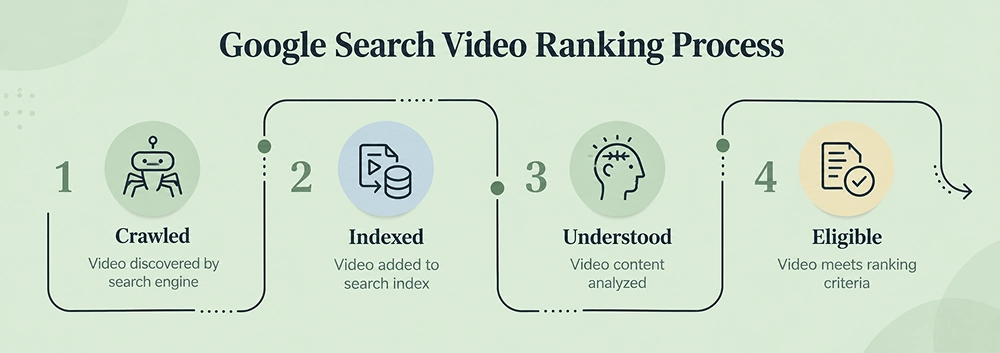
A page can get crawled or even indexed but never make it into Google’s index. A page can also be indexed while Google does not index the video on that page. Google has made it clear that it indexes videos only from indexed watch pages, and its video indexing report separates pages where a video was indexed from indexed pages where Google did not index the video.
Further, if your video has already been indexed, it can appear for one query and not another. Search intent, relevance, competition, and Google’s systems all influence when a video is shown.
So, if you ask “why my adult videos are not showing on Google?”, first find out which stage is failing before changing the page.
2. Monitor Video Performance in Google Search Console
GSC, or Google Search Console, should be an inseparable part of your adult video SEO workflow. This is a tool that gives you different ways to see what is happening after the video is published. Use it to monitor.
- Video indexing status
- Impressions
- Indexed video pages
- Clicks
- Search queries
- Average position
- Pages receiving impressions
- Video indexing issues
The video indexing report can be an asset here, as it shows how many indexed pages contain videos that Google has indexed. Besides, it also highlights the reasons that prevented other videos from getting indexed. You can also inspect an individual URL to see whether Google detected a video and what issue it found.
The performance report helps separate two different problems:
- “Google isn’t finding my videos” usually indicates issues related to crawling, video detection, page indexing, or access.
- “Google found my videos, but they get little visibility” points toward relevance, competition, search intent, titles, content, and site authority.
The performance report in GSC lets you review queries, page clicks, impressions, and average position, while the video search appearance filter can help you focus specifically on video visibility.
3. Correctly Identify Explicit Content
As an adult brand, you should make the nature of your content clear to Google systems. While Google can automatically detect explicit content, it recommends additional signals for sites to publish it.
<meta name = “rating” content=”adult”>
Google also recognizes the RTA rating value:
<meta name = “rating” content=”RTA-5042-1996-1400-1577-RTA”>
For explicit videos, the video sitemap can use <video:family_friendly> no </video : family_friendly>.
These signals can help Google understand which content should be treated as explicit for SafeSearch purposes.
4. Avoid SEO Practices That Can Hurt Adult Video Visibility
Shortcuts don’t really work in SEO; it takes thorough research, execution, and monitoring with consistency. But using SEO practices like duplicate video pages, doorway pages, copied descriptions, misleading metadata, cloaking, manipulative links, mass-generated thin pages, blocked video files, and inaccurate structured data can create problems.
The goal of your adult video SEO should not be to hide what your content is. It is to make legitimate content technically accessible, clearly classified, relevant, and useful.
5. Consider AI Search As Part of Your Adult Video SEO
AI-driven search adds another way for users to find out information, but the fundamentals remain the same.
To make your content easier for AI search systems to interpret, consider:
- Clear titles
- unique descriptions
- structured data
- consistent creator information
- logical site architecture
- contextual internal links, and
- useful HTML text
There’s no separate “AI SEO trick” for every adult video. For your adult brand, the practical takeaway is simple:
TL;DR: Build pages that clearly explain what the video is about rather than optimizing only for a search engine. That approach can support traditional search visibility while also giving AI-driven search systems better information to work with.
Also Read: Adult SEO vs Regular SEO
Conclusion: Build For Discoverability, Not Just Rankings
Getting your adult video onto Google is not about chasing rankings alone but about creating a clear path from your video to the searcher. The stronger that path, the easier for search systems to understand and surface your content.
Your job should be to make the video technically accessible to Google and AI searches and make the page genuinely relevant to what people search for.
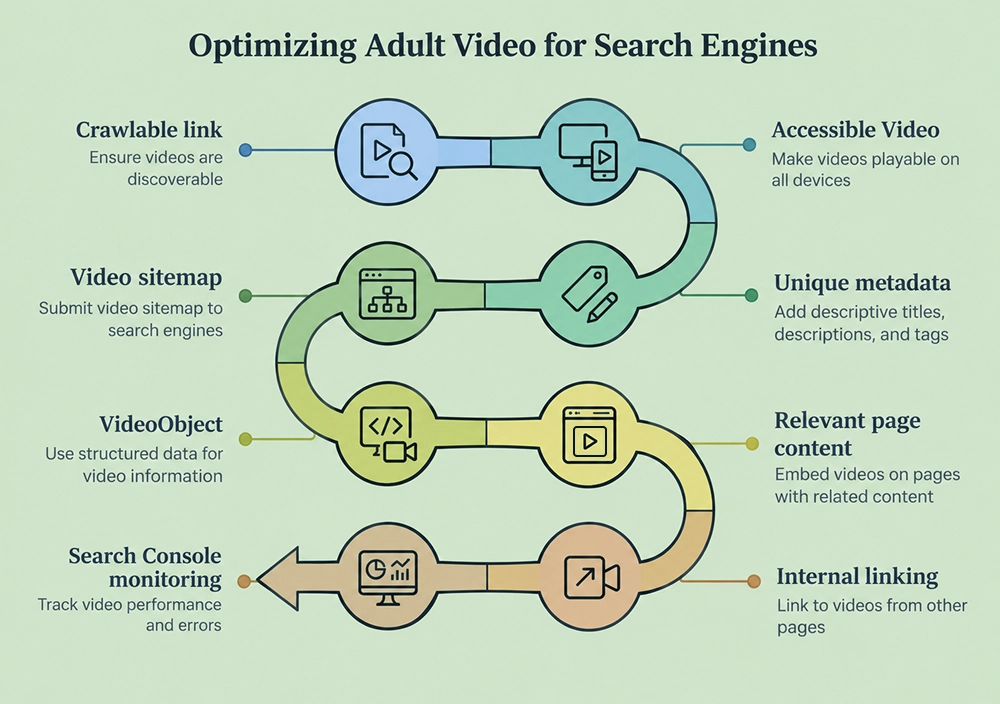
A practical workflow should look like this:
Crawlable link -> Accessible Video -> Unique metadata -> Video sitemap -> VideoObject ->Relevant page content -> Internal linking -> Search Console monitoring.
Expecting that one tactic will transform the visibility of your video overnight isn’t the right approach. Consistent technical checks, useful content, clear classification, and ongoing monitoring are more important.
Frequently Asked Questions
1. What is adult video SEO?
Adult video SEO is the process of optimizing adult videos and their webpages to help search engines discover, understand, index, and show them for relevant searches.
2. How long does Google take to find an adult video?
Google may find and crawl a new video page within several days, but there’s no specific timeline. Crawl frequency depends on the website, page links, and other factors.
3. Can a new adult website rank videos in Google?
Yes, a new website with videos can appear in Google if:
- its pages are crawlable,
- videos are accessible to bots,
- thumbnails are valid, and
- video metadata and structured data are properly implemented.
However, indexing does not mean your video will rank or get online visibility. It just means that Google has noticed your video and added it to its index.
4. Why is my adult video getting traffic but not appearing in Google video results?
Getting traffic does not always mean your video will appear in Google Video results. If your video isn’t appearing in Google search results despite getting good traffic, check whether Google has indexed your video, whether it is the main page content, and whether its thumbnails and video data are valid.
5. Can multiple adult videos rank for the same Google search?
Yes, multiple videos have a better potential of appearing for the same search when they are relevant and eligible. However, Google decides which results to show based on its ranking and search systems.
6. Does the length of the adult video affect its Google ranking?
Google ranking guidelines don’t consider video length as the only factor. While it can use duration as video metadata, it also focuses on relevance, page quality, accessibility, and other search factors.