

Google allows adult websites to appear in organic search results by using automated systems to identify and classify explicit content. Then, it uses SafeSearch to filter or blur results based on user settings, age-related protections, and search context. Also, Google’s search system considers search intent to avoid explicit content results for queries that aren’t relevant. Adult websites must follow content classification guidelines, provide responsible access controls, and allow Googlebot to crawl their content correctly.
Adult websites face a different set of challenges when it comes to Google visibility than most other businesses. Even if your website publishes relevant content and follows standard search optimization practices, its visibility can depend on how Google’s system identifies and distinguishes adult content.
When it comes to Google handling your adult content, one important aspect of this process is SafeSearch. It is an option that helps users control whether sexually explicit content appears in search results. However, it is important to understand that SafeSearch is not the same as a search penalty. Also, it doesn’t automatically prevent every adult website from appearing on Google.
So, if you want to understand how adult websites can maintain organic visibility, you should know how Google detects explicit content and applies filters, interprets search intent, and handles age-restricted pages. These considerations form an important part of Adult SEO, particularly if your website publishes a mix of explicit and non-explicit material.
Let’s dig deeper.
- How Does Google Identify and Classify Adult Content?
- What is SafeSearch and How It Works?
- How Does SafeSearch Blurring Affect Visibility of Adult Websites?
- How Does Google Rank Adult Content?
- Age Verification, Age Gates, and Google\u2019s Strict Content Restrictions
- How Can You Help Google Correctly Understand Your Adult Website Content?
- What Happens When Google Incorrectly Flags a Website as Explicit?
- How Do SafeSearch and Content Classification Affect Adult SEO?
- The Final Words
How Does Google Identify and Classify Adult Content?
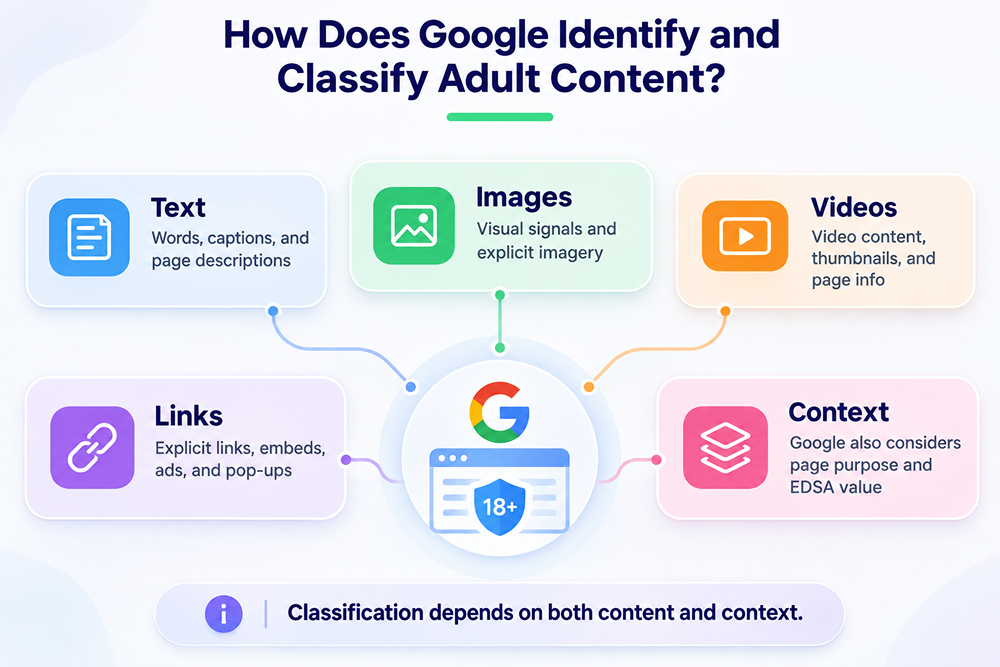
Google uses automated systems, machine learning, and different content signals like text, images, videos, etc., to detect sexually explicit material. Its systems don’t rely on a single keyword or image to decide whether a webpage contains adult content.
Instead, Google considers several elements, including:
- Text: Words, descriptions, captions, and surrounding page content that indicate explicit subject matter.
- Images: Visual elements showing nudity or sexually explicit activity.
- Videos: Video content and its associated thumbnails and page information.
- Links: Links leading to explicit pages, including those appearing in advertisements and pop-ups.
Moreover, when it comes to adult content promotion, Google also takes into consideration links, embedded content, and other elements displayed on a webpage to identify explicit material. This means a page that appears non-explicit at first glance could still be classified as explicit because of the media or advertisements it contains.
However, not every mention of sexual topics automatically makes a page explicit. Google\u2019s search system also considers context.
For instance, an article that discusses sexual health, medical research, or human anatomy may have educational, documentary, scientific, or artistic (EDSA) value. Google aims to distinguish such material from content intended primarily for sexual gratification.
This distinction is crucial because content classification is not just about identifying particular words or subjects. It also involves understanding what the page contains and the purpose it serves.
What is SafeSearch and How It Works?
SafeSearch, in simple terms, is a content-filtering feature by Google that helps users control whether explicit material, including pornography and graphic violence, appears in their Google search results.
It is particularly useful for families, schools, workplaces, and people who prefer not to encounter adult material while searching for information on Google.
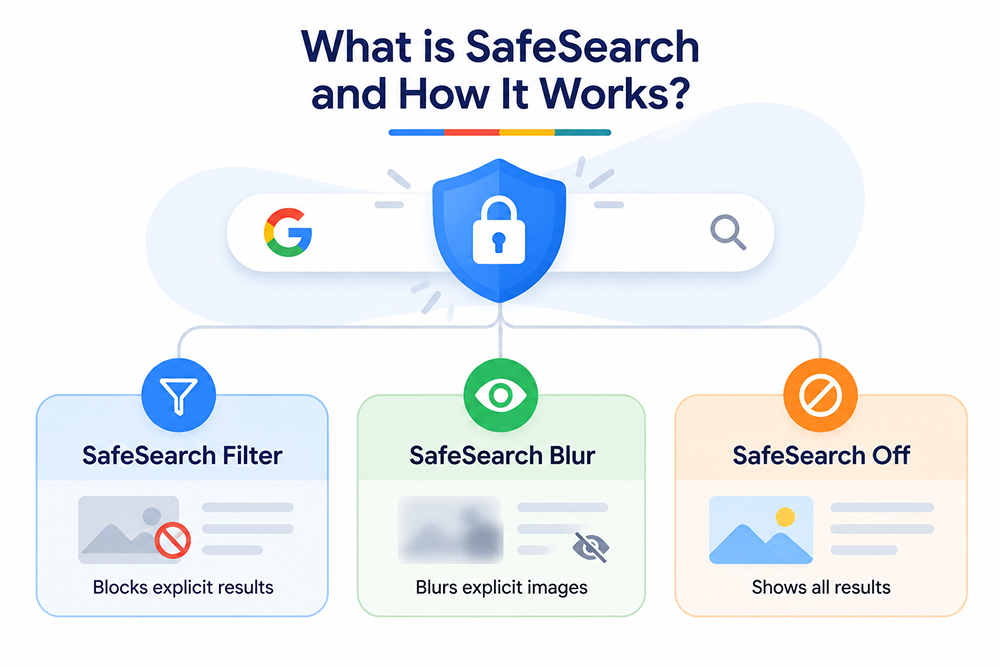
SafeSearch primarily offers three settings:
SafeSearch Filter
The “filter” setting blocks explicit results detected by Google’s systems. These may include explicit videos, images, text, and links.
It is the default setting when Google’s systems indicate that an account user may be under 18. Parents, schools, and network administrators can also enforce this setting.
SafeSearch Blur
The “blur” setting automatically blurs explicit images in search results. However, it does not remove every explicit result. You can still see relevant explicit text and links. Besides, you can also view an image by choosing to remove the blur, depending on your settings and circumstances.
SafeSearch Off
When the SafeSearch option is turned off, you can see all relevant results, including those that may contain explicit material.
However, an important thing to note is that turning SafeSearch off doesn’t mean Google stops applying its other content-safety systems. Its ranking and language-understanding systems still work to reduce unwanted explicit results when a search query does not indicate that the user is looking for such content.
Adult website owners should understand that SafeSearch only applies to Google Search. It does not control what users can access directly on other websites or through other search engines.
How Does SafeSearch Blurring Affect Visibility of Adult Websites?
SafeSearch and Blur work differently, which is important for adult website owners to understand.
Under the Blur option, Google blurs explicit images in search results rather than blocking all detected explicit content. However, users may still see relevant explicit links and text.
For example, someone searching for a general topic might see an image thumbnail blurred while still seeing the page title and description. This does not mean the webpage has escaped explicit content classification. Google’s system can still recognize the page as explicit and apply the appropriate filtering rules.
Another important consideration is mixed-content websites.
Let’s say you own a website that publishes general relationship articles alongside explicit videos and images. Even if an individual article is non-explicit, Google’s systems may categorize the wider website as explicit if content is not properly separated on your site.
This can affect whether non-explicit pages appear when SafeSearch Filter is enabled.
As per Google, grouping significant amounts of explicit content on a separate domain or subdomain is recommended. This helps its systems distinguish explicit sections from content intended for a broader audience.
For example, a website could host its general informational articles on its main domain and its explicit content on a separate subdomain.
While this approach is not mandatory for every adult website, it can prevent your entire mixed-content website from being classified as explicit.
How Does Google Rank Adult Content?
A common misconception is that Google penalizes every website that publishes adult website content.
That is how its search system works.
Google can show adult websites in organic search results, but whether a specific page appears depends partly on:
- The user’s query
- SafeSearch settings
- Google’s assessment of content relevance and quality.
The Role of Search Intent
Search intent refers to what a person wants to find when entering a query.
Consider these two searches:
- “How does sexual health affect relationships?”
- “Explicit adult videos”
You could notice that both queries relate to adult topics, but they differ in their purpose.
The first search has an informational intent; the user wants educational information. The second clearly indicates an interest in explicit material.
That’s how Google’s query-understanding systems work-they help determine whether a search is seeking explicit content. They then use this understanding to reduce the chances of showing sexually explicit results for unrelated searches.
This is why an adult website might appear for a clearly explicit query but not for a general informational search.
SafeSearch Filtering Vs Organic Ranking
These are two different processes.
Organic ranking helps determine which relevant pages should appear and in what order. On the other hand, SafeSearch determines which detected explicit results should be filtered or blurred according to the user settings.
Let’s say an adult site might be indexed and have strong organic rankings for a relevant query. However, users who have enabled SafeSearch Filter may not see its explicit pages. This is not necessarily a penalty or a de-indexing issue. It may simply be the result of the user’s filtering preferences.
In other words:
Being indexed, ranking for a query, and being eligible to appear under a particular SafeSearch setting are separate considerations.
Also Read: Recovery plan for Adult Websites penalized by Google
Age Verification, Age Gates, and Google\u2019s Strict Content Restrictions
Age verification is an important consideration for adult sites, particularly those that publish sexually explicit material. However, website owners should know the difference between protecting visitors and allowing search engines to access content.
Age Gates Vs. Age Verification
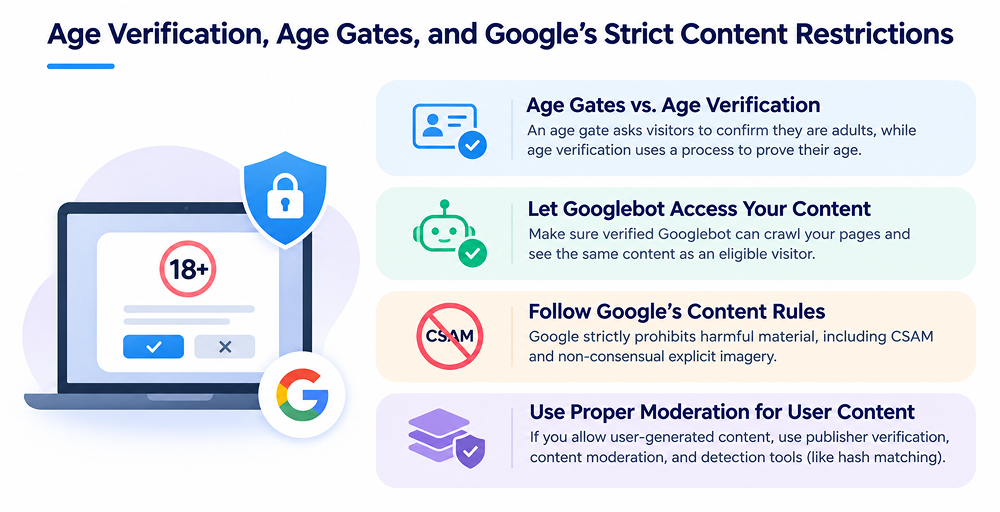
An age gate is an access screen that asks visitors to confirm they are adults before entering a website or viewing restricted content.
Age verification goes further by using an appropriate verification process to establish that a visitor meets the required age. The legal requirements for age assurance vary by country and jurisdiction. Adult website owners must follow the laws that apply to their visitors and business operations.
However, implementing an age gate incorrectly can create problems if it prevents Googlebot from accessing the actual webpage.
For example, if Googlebot only sees an age-confirmation screen instead of the page\u2019s text, images, and videos, Google may not be able to understand or properly evaluate that content.
Why Googlebot Must Be Able to Crawl Your Website
Suppose your website displays an age-verification screen before showing any page content. If Googlebot encounters the same restriction and cannot access the actual page, Google may not understand what the page contains.
Besides, it may not be able to access the text, images, or videos needed to evaluate and classify the content.
Google strongly advises letting verified Googlebot requests pass through without triggering the age gate.
This is not the same as the elimination of age restrictions for human visitors. Rather, the owners of the websites should make sure their systems accept valid Googlebot requests and serve the correct content to the crawler.
Googlebot requests should be verified rather than trusted simply because a request claims to come from Google.
Importantly, serving different content to Googlebot to manipulate rankings is not an acceptable solution. The underlying page content provided to the crawler should be the same as that provided to an eligible human visitor after passing the age restriction.
Content that Google Strictly Prohibits
Implementing age verification alone in your adult content doesn’t make it acceptable, regardless of its type.
Google takes a particularly strict approach to harmful material, including sexual abuse material (CSAM) and non-consensual explicit imagery.
Websites that allow user-generated content should have proper publisher verification and content moderation processes. This includes proactively identifying and removing prohibited material.
Google recommends industry-standard approaches, including hash matching to identify known harmful content and classifiers to help detect previously unidentified material. These measures are important for protecting users, preventing the distribution of illegal content, and maintaining a responsible publishing environment.
How Can You Help Google Correctly Understand Your Adult Website Content?
Google can automatically identify explicit material, but website owners can provide additional signals to help its systems understand their content. Here are some of Google’s recommended practices:
Use the Appropriate Adult Content Metadata
As per Google, it recommends marking pages containing sexually explicit material with an adult content rating. Website owners can add the following meta tag to the page’s HTML:
<meta name=”rating” content=”adult”>
Google also recognizes the RTA rating:
<meta name=”rating” content=”RTA-5042-1996-1400-1577-RTA”>
You can use either option; there is no need to add both. This metadata helps identify explicit pages. It is not a ranking boost, nor does it guarantee that Google will classify every page exactly as intended.
Use the Video Family-Friendly Tag
Websites containing both general and explicit videos should pay attention to their video sitemap. Use the video:family_friendly tag with the value no for videos containing explicit material. This helps Google understand which videos should not appear when SafeSearch filtering is enabled.
Separate Explicit and Non-Explicit Content
If a website contains substantial amounts of both explicit and non-explicit material, Google suggests grouping explicit pages on a separate domain or subdomain.
This helps prevent the entire website from being classified as explicit when only certain sections contain adult material.
Manage Third-Party Content and Advertisements
Content classification does not depend only on what a website owner publishes directly. External links, advertisements, pop-ups, and user-generated content can also influence how Google understands a page.
For example, a general informational page containing an explicit advertisement may still struggle to avoid triggering content classification signals.
Website owners should therefore monitor third-party placements, moderate user submissions, and review external content appearing on their pages.
What Happens When Google Incorrectly Flags a Website as Explicit?
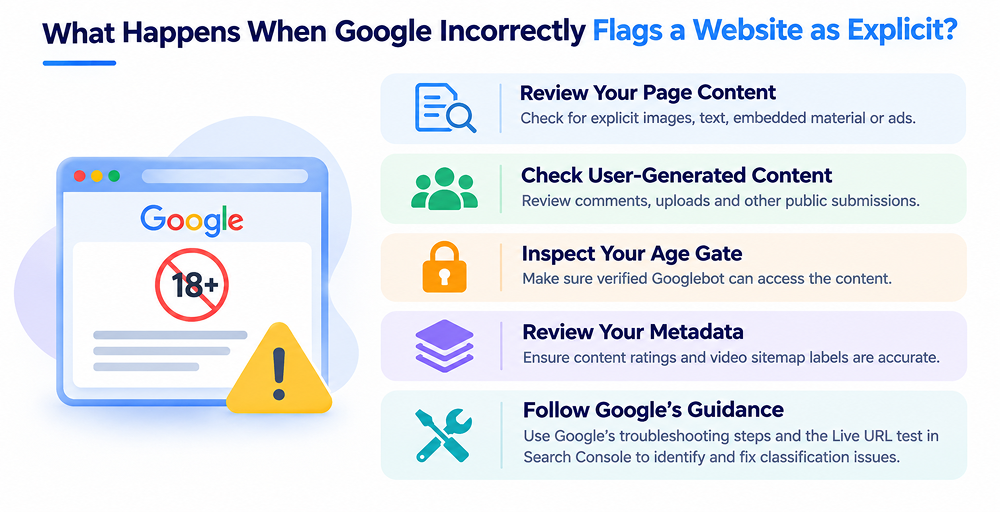
Sometimes, a website or a particular page may be classified as explicit when its content is not intended for an adult audience. This can happen because of explicit advertisements, unmoderated user-generated content, incorrectly configured video metadata, or age gates that prevent Google from accessing the actual page.
If you suspect incorrect classification, start by checking the following:
- Review your page content: Look for explicit images, text, embedded material, or third-party advertisements that may have triggered classification.
- Check user-generated content: Review comments, uploads, and other public submissions for inappropriate material.
- Inspect your age gate: Confirm that verified Googlebot requests can access the relevant content.
- Review your metadata: Make sure adult content ratings and video sitemap labels accurately describe the pages and videos.
- Check Google’s troubleshooting guidance: Google provides specific instructions for identifying and resolving incorrect explicit-content classification.
It is also recommended to use the Live URL test in Google Search Console to check whether Googlebot can access a page without facing an age gate.
After correcting the underlying issue, allow Google’s systems time to recrawl and reassess the affected pages. Reclassification is not immediate, and Google does not guarantee a specific recovery timeline.
How Do SafeSearch and Content Classification Affect Adult SEO?
SafeSearch is only one part of the broader search ecosystem. For your adult website, content classification, crawler accessibility, search intent, and website structure all contribute to how content is understood and displayed.
For instance, a website may have relevant content and strong external references, but if Googlebot cannot access its pages, it may struggle to evaluate them properly.
Similarly, if explicit content is mixed with general informational pages without clear separation, Google’s systems may classify a wider portion of the website as explicit.
This is why adult website owners need to understand both Google content policies and its technical requirements.
Content classification and organic authority also serve different purposes. When Google is able to correctly identify explicit content, it can easily apply its filtering system, while relevant backlinks can establish a site’s authority and credibility in its niche.
For businesses investing in link building for adult brands, it is important to understand that backlinks cannot override SafeSearch restrictions, incorrect classification, or violations of Google’s policies.
A sound adult content strategy should account for all these factors rather than treating link acquisition as a standalone solution. Understanding these distinctions is key to building a sustainable search presence in the adult industry.
Also Read: How Do Backlinks Impact Adult Site Rankings?
The Final Words
Google does not automatically exclude adult websites from organic search. Instead, it uses content classification systems, search intent, and SafeSearch settings to decide how explicit material should be displayed to different users. For adult website owners, understanding these processes is essential.
Proper content labeling, responsible age verification, accessible crawling, effective moderation, and clear separation of explicit and non-explicit material can help Google interpret a website more accurately.
Ultimately, succeeding in this space requires more than traditional optimization. It requires an understanding of Google’s specific content policies and how they influence search visibility.
Frequently Asked Questions
Does Google penalize websites that contain adult content?
No, Google doesn’t automatically penalize websites for publishing adult content. However, its systems may classify explicit pages and filter them through SafeSearch, depending on the user’s settings and search intent.
Can adult websites rank on Google with SafeSearch enabled?
Adult websites can appear in Google Search, but explicit results may be filtered when SafeSearch is enabled. Whether a page appears depends on its content classification, the search query, and the user’s filtering settings.
How can I stop Google from incorrectly classifying my website as explicit?
Review your website for explicit advertisements, embedded media, and user-generated content. Use appropriate adult content metadata, separate explicit sections where necessary, and ensure Googlebot can access your pages without encountering age-gate restrictions.